
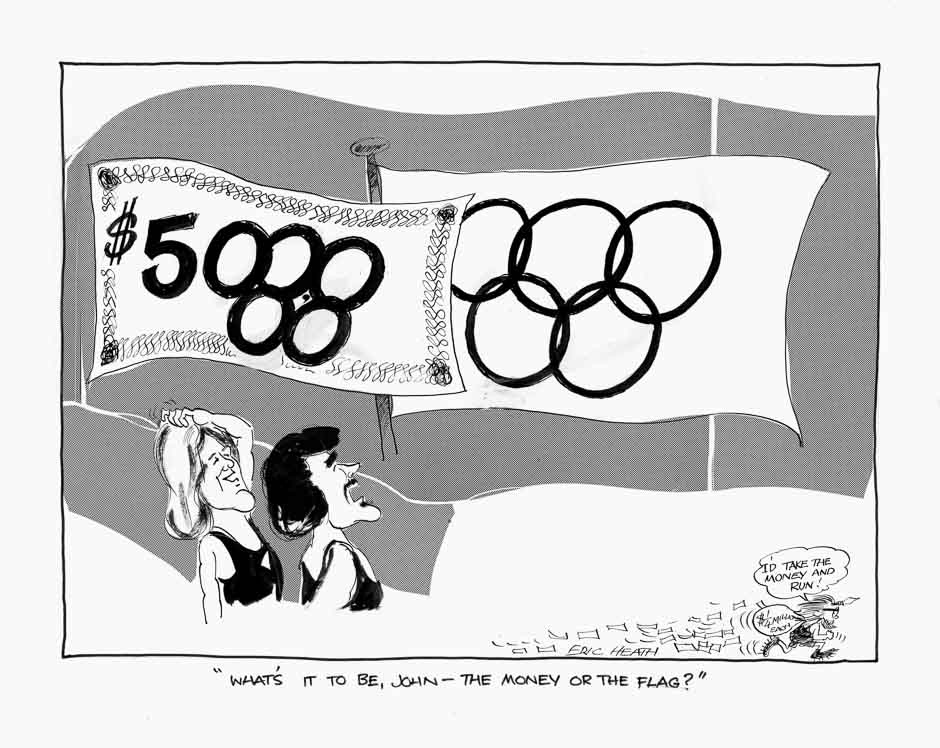
In this 1976 cartoon athlete Rod Dixon asks the question of fellow athlete John Walker, while above them floats a $500,000 note and the Olympic flag.
'Shamateurism' at the Olympics
For most of their history, the Olympic Games welcomed only those who competed for pleasure and spurned all monetary rewards. Until the late 20th century, officials pursued professionals far more vigorously than drug cheats. Only in the 1980s did the International Olympic Committee (IOC) acknowledge that all elite sportspeople were in fact being paid in some way.
The founder of the modern Olympics, Pierre de Coubertin, embraced the ideal of amateur sport espoused by the leisured English gentlemen who codified the rules of many games in the 19th century. Most sports soon split into amateur and professional bodies that ignored each other's existence. The Olympic movement remained resolutely amateur after briefly allowing professional fencing instructors to compete. Even competing against professionals could mean disqualification.
The first high-profile case was that of the American decathlete Jim Thorpe, who was stripped of the two gold medals he won at Stockholm in 1912 because he had played professional baseball. The great Finnish distance runner Paavo Nurmi was barred from competing at Los Angeles in 1932 after allegations he had received excessive travel expenses. The Finns got their own back in 1952 when Nurmi lit the Olympic flame at Helsinki. Swiss and Austrian skiers boycotted the 1936 Winter Olympics because skiing teachers were prevented from competing.
Sportspeople from the Communist countries which competed at the Olympics from 1952 were in effect full-time athletes, despite being nominally students, soldiers or otherwise employed. Western Europeans – and New Zealanders – forced to train in their spare time resented the success of the Soviets and East Germans. For their part, many American sporting stars received lucrative college scholarships.
The exclusion of the Austrian skier Karl Schranz from the 1972 Winter Olympics for receiving money from sponsors was a watershed. IOC President Avery Brundage's attempt to exclude 40 other ‘professional' athletes was rejected by his colleagues. The ban on earning money from endorsements was progressively relaxed, with each Olympic sport's governing body now making its own rules. The word 'amateur' disappeared from the Olympic Charter.
In 1988 professional tennis players appeared at the games, and four years later the American basketball ‘Dream Team' of NBA stars trounced their opponents. Today only two Olympic sports restrict entry: football players must be aged under 23 (three older players are permitted per squad), while boxing is conducted under amateur rules (although boxers are eligible for the cash prizes offered by some National Olympic Committees).
Links


Community contributions