
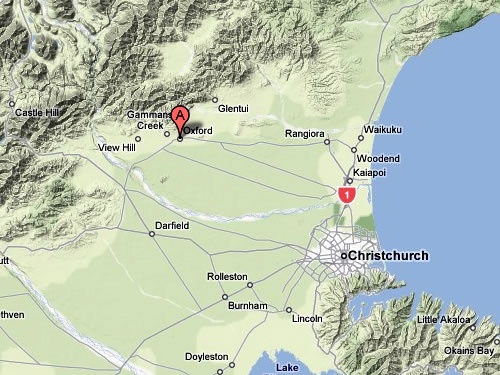
Google map showing location of Oxford, the small town on which Littledene is based.
Patterns of change
Crawford Somerset's Littledene: a New Zealand rural community (1938) was a groundbreaking sociological study of a typical New Zealand small town - Oxford in North Canterbury. According to commentator Brian Easton, the book 'combines the wry insights of a sociologist and the lyric observations of a poet'.
Hugh Crawford Dixon Somerset and his wife, Gwendolen, were outstanding figures in New Zealand adult education. In 1920-1 Crawford (as he was known) and Gwen Alley, then both students at Christchurch Training College, attended the first Workers' Educational Association (WEA) summer school at Oxford, which included lectures on drama by James Shelley and economics by J.B. Condliffe. Gwen came from an intellectual and literary family: one brother, Rewi, achieved fame for his educational work in China, while another, Geoffrey, became New Zealand's first national librarian.
In 1924, at Condliffe's urging, Crawford established a WEA tutorial class for adults in Oxford, where Gwen was then teaching; the couple were married in 1930. After spending 1936-7 in Britain and the United States on a joint Carnegie fellowship, the Somersets undertook a pioneering sociological study of Oxford. Littledene was published in 1938 by the New Zealand Council for Educational Research. Although it was the couple's joint work, Crawford was credited as its sole author.
Littledene provides a fascinating insight into the geography, economy and social life of small-town New Zealand. At least until the mid-1920s, the branch railway was Oxford's ‘chief line of communication' with the outside world. The farmer's regular ‘trip to town' also offered opportunities for social interaction:
The whole journey of 40 miles [to Christchurch], with all the many stops on the way, took a full three hours. But few ever found it tedious. The train was as much a meeting place as a means of conveyance - a kind of club on wheels. Everyone knew everyone else, and so a trip to town had the excitement of a dozen neighbourly visits in one. The silence of people who work in the isolation of farming was broken in talk and one arrived in town briefed and relaxed with the latest gossip. As one farmer remarked in recalling times past, ‘the train was a good place for an occasional loaf and a yarn'.
At the time, Christchurch was itself ‘essentially a rural centre':
... to the farmer, coming in for the day, the city was an extension of his farm. The people he recognized in the streets and hotel, were, like himself, ‘in from the country'; those he sought out in his usual haunts, at the saleyards, the banks, the shops, the law offices, the stock and station agencies, were deeply concerned with people from the country.
In 1938 the Somersets became co-directors of New Zealand's first community centre, established in Feilding. Crawford contributed to the Making New Zealand series (1940) and wrote other works, including Child nutrition in a rural community (1941) and a school bulletin, The dairy farm (1947). In 1947 he was appointed senior lecturer in education at Victoria University College. During the 1950s he undertook further visits to Oxford, which resulted in ‘Littledene revisited', published along with the original book as Littledene: patterns of change (1974). Gwen, meanwhile, became a leading figure in the playcentre movement.


Community contributions