
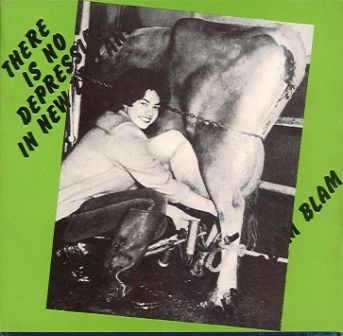
Cover of the single 'There is no depression' by Blam Blam Blam
An alternative anthem?
The year 1981 was a time of great economic anxiety in New Zealand, which was characterised by rising unemployment, industrial strife and a growing resentment of the Muldoon government. On the social/political front an impending Springbok rugby tour of New Zealand carried with it the fear of massive civil unrest. This sense of unease was captured by the seminal Auckland band Blam Blam Blam, which, in July 1981, released ‘There is no depression in New Zealand’.
The song’s biting, satirical lyrics, written by Richard Von Sturmer, struck a chord with the protest movement, and some adopted it as an unofficial national anthem. It was also commercially successful and went gold a month after its release.
There is no depression in New Zealand; there are no sheep on our farms,
There is no depression in New Zealand; we can all keep perfectly calm,
Everybody’s talking about World War Three; everybody’s talking about World War Three,
But we’re as safe as safe can be, there’s no unrest in this country
We have no dole queues, we have no drug addicts, we have no racism, we have no sexism, sexism, no, noThere is no depression in New Zealand; there are no teeth in our heads
There is no depression in New Zealand; we sleep in a well made bed
Oh but everybody’s talking about World War Three, yes everybody’s talking about World War Three,
But we’re as safe as safe can be, there’s no unrest in this country
We have no SIS, we have no secrets,
We have no rebellion; we have no valium, valium, no, no
There is no depression in New Zealand; there are no sheep on our farms,
There is no depression in New Zealand; oh we can all keep perfectly calm,
perfectly calm, perfectly calm, perfectly calm, perfectly calm...
Blam, Blam, Blam had another hit in December with ‘Don't fight it Marsha’. Their debut album, Luxury length, released in July 1982, reached number four on the charts. But things took a turn for the worse, literally, when the band’s van crashed while touring, and bass player Tim Mahon was seriously injured. This effectively finished off a band that Simon Grigg described in retrospect as ‘one of the most important New Zealand bands of the early eighties, easily the most musically literate, hugely influential and one whose legacy goes far beyond their small number of releases’.
Blam, Blam, Blam's drummer/singer Don McGlashan went on to form, with Harry Sinclair, the acclaimed music/theatre/film act The Front Lawn in 1985. After that group disbanded in 1990, he became the force behind the Mutton Birds (1991–2002). Five songs written by McGlashan made it onto the Australasian Performing Right Association’s top 100 New Zealand songs. In recent years he has enjoyed success as a solo artist with the albums Warm hands (2006) and Marvellous year (2008). He has also written scores for movies and television, including Toa Fraser's debut feature film No 2.
Links
- Simon Grigg's Blam Blam Blam page
- 1981 Springbok Tour
- See the video for 'There is no depression' (Ngā Taonga Sound and Vision)
- See Blam Blam Blam singing it live (YouTube)


Community contributions