
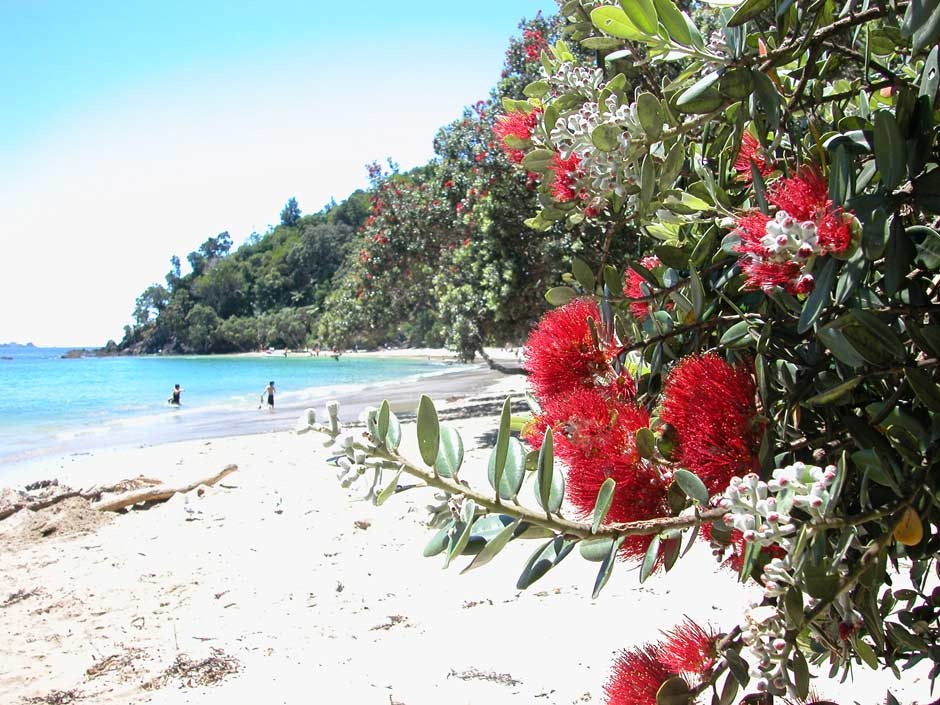
Pohutukawa trees

Pohutukawa trees

The pohutukawa tree (Metrosideros excelsa) with its crimson flower has become an established part of the New Zealand Christmas tradition. This iconic Kiwi Christmas tree, which often features on greeting cards and in poems and songs, has become an important symbol for New Zealanders at home and abroad.

In 1833 the missionary Henry Williams described holding service under a ‘wide spreading pohutukawa’. The first recorded reference to the pohutukawa as a Christmas tree came in 1867 when the Austrian geologist Ferdinand von Hochstetter noted that settlers referred to it as such. The pohutukawa, he observed, ‘about Christmas … are full of charming … blossoms’; ‘the settler decorates his church and dwellings with its lovely branches’. Other 19th-century references described the pohutukawa tree as the ‘Settlers Christmas tree’ and ‘Antipodean holly’.

In 1941 army chaplain Ted Forsman composed a pohutukawa carol in which he made reference to ‘your red tufts, our snow’. Forsman was serving in the Libyan Desert at the time, hardly the surroundings normally associated with the image of a fiery red pohutukawa tree. Many of his fellow New Zealanders, though, would have instantly identified with the image.

Today many school children sing about how ‘the native Christmas tree of Aotearoa’ fills their hearts ‘with aroha’.

Pohutukawa and its cousin rata also hold a prominent place in Maori tradition. Legends tell of Tawhaki, a young Maori warrior, who attempted to find heaven to seek help in avenging the death of his father. He fell to earth and the crimson flowers are said to represent his blood.

A gnarled, twisted pohutukawa on the windswept cliff top at Cape Reinga, the northern tip of New Zealand, has become of great significance to many New Zealanders. For Maori this small, venerated pohutukawa is known as ‘the place of leaping’. It is from here that the spirits of the dead begin their journey to their traditional homeland of Hawaiiki. From this point the spirits leap off the headland and climb down the roots of the 800-year-old tree, descending into the underworld on their return journey.

Credit:

Image: Melanie Lovell-Smith, Te Ara

How to cite this page: 'Pohutukawa trees', URL: http://www.nzhistory.net.nz/media/photo/pohutukawa-flowers, (Ministry for Culture and Heritage), updated 8-Dec-2011

Community contributions


Unknown
18 Jun 2011
Possums hurt the pōhutukawa and the pōhutukawa is endangered.
Me
22 Mar 2011
A pohutakawa can grow up to 60m tall
Moreen
08 Feb 2011
11 years ago we brought 25 Pohutukawa trees from a native tree wholesaler in Te Hana. They have never flowered. We live on a mountain range outside of Warkworth and we can see both coasts of NZ. Is there something wrong with the plants or does it take longer to flower?. We actually couldn't wait for the natives to flower and so purchased some hybrids they flowered the first year and nothing ever since.
Pam
08 Feb 2010
I was recently asked about the maori meaning of what happens when the pohutukawa tree only half flowers. I know that something will happen in the year but not sure what the actual meaning is. Any info would be great
Maggy Wassilieff
06 Feb 2010
The hanging roots of pohutukawa are aerial roots ---also known as adventitious roots. Some pohutukawa trees are more prone to producing them than others. Pohutukawa are capable of delaying their flowering (flowering buds held at an early developmental stage)--- probably a temperature-dependent response. Yellow-flowered pohutukawa are natural forms that have been selected by horticulturalists and planted widely throughout NZ for their novelty value. flower colour usually results from a combination of pigments (chlorophyll, carotenoids and anthocyanins). if the plant is missing a gene (or has a faulty gene)that determines the production of one of the pigments, then the flower colour will differ from that of the normal plants. I assume that the yellow flowered pohutukawa cannot produce anthocyanins in their stamens. Some of thia stuff is discussed in "Pohutukawa & rata" by Phillip Simpson. Te Papa Press. 2005.
rOdAhO
04 Feb 2010
What are hanging 'roots' on the pohutukawa. I have always thought they were aerial roots but cannot fine any information about them
mia
25 Jun 2009
hi I was just wondering how tall can pohutukawa grow?
Beattie
07 Apr 2009
This really helped me with my science homework ! i was so happy to find this ! bt i still need more ! we buy and plant the trees every year ! well we try 2 anyways ! thnkz mch
Dakota
18 Mar 2009
Hi Thanks for info!!!!!
anna
12 Mar 2009
hello i've got a pohutukawa tree that blosemed in late december! I do not know what to do

What do you know?

Can you tell us more about the information on this page?
Perhaps you have a related experience you would like to share?

The content of this field is kept private and will not be shown publicly.
CAPTCHA
This question is for testing whether you are a human visitor and to prevent automated spam submissions.

Comments will be reviewed prior to posting. Not all comments posted. Tell me more...