
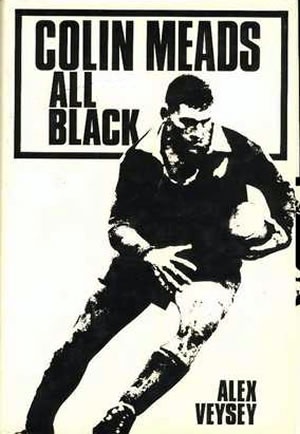
Cover of Alex Veysey’s Colin Meads: All Black (1974).
Seasons of gold
When thoughts turn to great New Zealand literary moments, titles such as The whale rider, Once were warriors and The luminaries spring to mind more readily than Iceman: the Michael Jones story or Save the last ball for me: Chris Pringle. Lance Cairns’ autobiography Give it a heave may not have won a Montana Book Award either, but sport has been a source of inspiration for many New Zealand writers. Though some loathe the subject, many Kiwis can’t have enough sports books.
The stereotypical notion of Kiwis in love with ‘rugby, racing and beer’ might seem outdated in the 21st century, but sport remains popular with publishers, booksellers and readers. Leading New Zealand sportswriter Joseph Romanos noted that a ‘great’ All Black’s biography could expect to sell 20,000 copies. According to Booksellers NZ this level of sales is in the silver category for Premier New Zealand Bestsellers, ranking alongside great contemporary writers such as Maurice Gee and Patricia Grace.
Before the 1970s Kiwi sporting biographies were rare. Notable exceptions included George Nepia (1964), in which ‘one of the great All Blacks ever’ told his story to the legendary sportswriter Terry McLean. Norman Harris’ more intriguingly titled It's me tiger: the Peter Jones story followed in 1965, and in 1966 A.H. & A.W. Reed published Don Clarke’s autobiography, The boot. Greater television exposure from the 1970s turned many of our sports figures into media stars. Stories about their lives, experiences while on tour and tips on playing the game became increasingly popular. The notion that ‘what happens on tour stays on tour’ has faded away in the professional era. With publishers seeking the ‘outspoken and provocative’, some sports figures have sold more books than their playing ability perhaps deserved.
Announcing the winners of the inaugural New Zealand Book Month competition in 2006, David Kirk, former All Black captain and CEO of one of Australasia’s largest media companies, summed up how central sport was to many New Zealanders:
sporting success has always played a big part in defining what it is to be a New Zealander, and still does. But just as important is the contribution our writers make to our national life. They stir our feelings and imagination and they make us think.
As the national game, rugby has dominated sports writing in this country. Colin Meads, long regarded as our greatest rugby player, has been the subject of two biographies, written nearly 30 years apart. Alex Veysey’s Colin Meads: All Black (1974) was the work of one of New Zealand’s foremost sportswriters. For some it is still the benchmark by which all sports biographies in New Zealand are measured. It sold more than 60,000 copies, including 3000 overseas. Leading New Zealand poet Brian Turner revived the Meads legend in 2002 with the publication of Meads, a commentary on the impact of professionalism on rugby that compared Meads’ era with the modern game. Sales of more than 50,000 – enormous in the context of New Zealand publishing – highlighted the continued relevance of the subject matter for many readers. Playwright Greg McGee's biography of a later All Black legend, Richie McCaw, The open side, was said to have sold 120,000 copies around the world within months of its release in 2012.
Many sporting books have a limited shelf-life. The biography usually marks the end of a player’s career, a literary swansong designed to capitalise on the nostalgia the public feel for a departing favourite. This helps sell books, but usually for a short time only; Christmas and Father’s Day are popular retailing opportunities. A few months after their release, many can be found in remainder bins or online auctions. As Jeff Wilson and Ron Palenski put it in their joint biography of the All Black outside back, ‘the Seasons of Gold are all too brief'.


Community contributions