
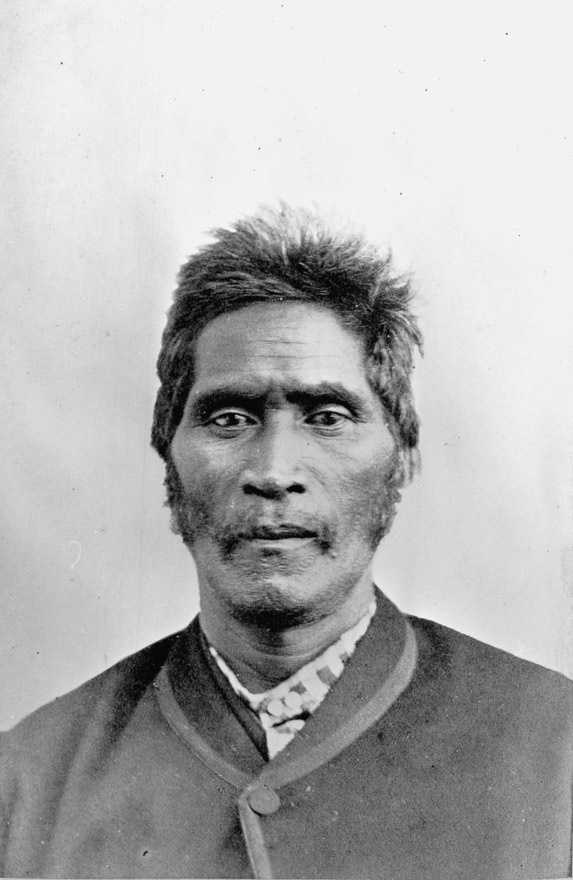
Wiremu Tāmihana, 1865
Wiremu Tāmihana Tarapīpipi Te Waharoa, born around 1805, belonged to the Ngāti Hauā iwi of the Tainui confederation. As a young man he took part in several war expeditions. Mentored by A.N. Brown, a Church Missionary Society missionary at Matamata, he quickly learned to read and write in Māori.
After his father’s death in 1838 he became an influential chief and resisted pressure to continue fighting neighbouring tribes. He practised Christian beliefs within a traditional Māori framework.
In 1838 Tāmihana began building a new village at Te Tāpiri whose residents were expected to adhere to the Ten Commandments. Within a year about 300 people were living there and the church could host 1000 worshippers. Although Tāmihana did not sign the Treaty of Waitangi in 1840, he was not hostile towards Pākehā settlers.
In the early 1850s Tāmihana established another Christian settlement, at Peria. It included a post office, schoolhouse and flour mill, and was administered by a rūnanga (tribal council). Peria soon became a busy and prosperous kāinga. John Gorst, the Waikato Civil Commissioner (government representative), was impressed with Ngāti Hauā’s social and political organisation, which he attributed to Tāmihana’s influence.
Tāmihana, like many Māori, became concerned at growing European encroachment, land purchases and the government’s failure to support Māori social and political structures. He advocated a pan-tribal movement that would not only provide protection against European settlement but also develop its own system of laws and maintain peace among the tribes. Tāmihana took a leading role in the formation of the King Movement and the election of Pōtatau Te Wherowhero as the first Māori King. Accordingly, he became known as ‘Kingmaker’. When Te Wherowhero was confirmed as king in May 1859, Tāmihana placed a Bible over his head. Tāmihana’s descendants still perform this ritual when Māori monarchs are crowned.
Tāmihana remained deeply involved in the King Movement and helped set up a Maori-language newspaper, Te Hokioi. When war broke out in Taranaki in 1860 he acted as mediator. But the government remained suspicious of his motives and hostile to the Kīngitanga. Some Waikato men fought in Taranaki, although Tāmihana and others tried to dissuade them. Governor Gore Browne seized on this to accuse Waikato of violating Te Tiriti o Waitangi and demand their submission. Tāmihana replied that the King Movement did not conflict with the British Queen’s authority: King and Queen could exist together, with God over both.
In 1863 Governor George Grey ordered a British army to cross the Mangatāwhiri Stream and invade the lands of the Kīngitanga. A number of hard-fought battles followed as the skilfully prepared Māori defences were overwhelmed or outflanked. Fighting did not end until the Waikato tribes withdrew into Ngāti Maniapoto territory, which became known as the King Country. The conflict then moved to Tauranga. Tāmihana took a leading role in seeking redress in the wake of the war and the massive land loss that followed. He died in 1866.
Tāmihana was a remarkable man whose vision of peace and prosperity for his people was disrupted by a conflict not of his making.


Community contributions