
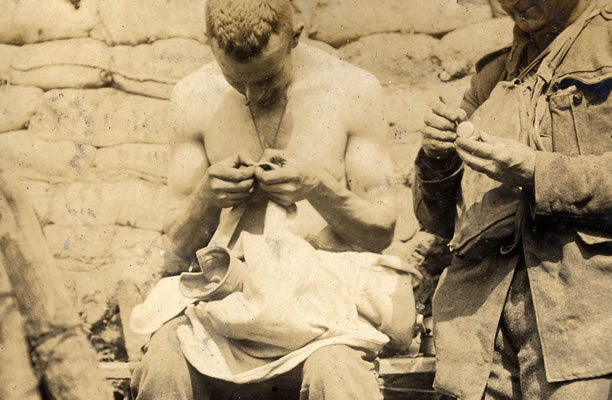
While the drama of combat – going over the top, facing machine-gun fire and enduring terrifying artillery barrages – naturally dominates historical accounts of the Western Front, in reality, large-scale battles were rare. Most of a soldier’s time in the trenches involved tedious scheduled rotations through various trench lines and rear area billets.
Individuals spent only a few days a month in a front-line trench. Daily life here was a mixture of routine and boredom – sentry duty, kit and rifle inspections, and work assignments filling sandbags, repairing trenches, pumping out flooded sections, and digging latrines. Any free time was usually spent reading or writing letters or diaries, playing cards or trying to snatch a few moments of sleep.
Still, life in the front line was always dangerous. Snipers’ bullets and stray shell-bursts were constant hazards. Periodically, the trenches were subjected to heavy artillery bombardments in support of raids and patrols, or against groups of troops moving up to the line.
Surviving in mud
Apart from the Germans, the New Zealanders' biggest enemy on the Western Front was the mud. Indeed, the flooded trenches and churned landscape of the battlefields are among the most potent symbols of the First World War. This was particularly evident at Passchendaele, which was notoriously sodden due to the wet weather and the high water-table of this low-lying area, much of which was reclaimed marshland. Conditions were made much worse by the shelling, which had disrupted normal drainage.
Finding a dry spot to rest or sleep was often a challenge even though pumps were used to remove water from trenches and dugouts. Many troops succumbed to trench foot, a fungal infection caused by immersion in cold water. Rats and lice were soldiers' constant companions: rats, having gorged on corpses, allegedly grew 'as big as cats'; lice were the (then unknown) vector of another common wartime ailment, trench fever.
The stink of war
Then there was the smell. Stinking mud mingled with rotting corpses, lingering gas, open latrines, wet clothes and unwashed bodies to produce an overpowering stench. The main latrines were located behind the lines, but front-line soldiers had to dig small waste pits in their own trenches.
Gas attacks
Soldiers in the front line trenches had to guard against gas attacks. By 1916, both sides were using poison gas and had developed measures to minimise its impact, notably increasingly sophisticated gasmasks. While the sulfide-based blister agent 'mustard gas' – so-called because of its smell – was only used from late 1917, it became notorious because of the injuries it caused to skin, lungs and eyes. The choking agents chlorine and phosgene were more commonly used gases.
The application of chloride and lime to protect against disease and infection only added to the stink. While the sights, smell and noise of the front line frequently overwhelmed new arrivals, old hands quickly became hardened to the discomforts and dangers of trench life.
Night work
At night, the trenches often became hives of activity. Despite the continued risk of night bombardment or trench raids, the cover of darkness allowed troops to attend to vital supply and maintenance tasks. Rations and water were brought to the front line, and fresh units swapped places with troops returning to the rear for rest and recuperation. Construction parties beavered away repairing trenches and fortifications, laying duckboards and wire and preparing artillery positions.
To help detect enemy activity along the front, both sides established observation (‘listening’) posts in front of their trenches. Patrols were also sent into no-man’s land to help familiarise soldiers with the battlefield terrain, locate enemy listening posts, and identify gaps in the wire defences where German patrols entered no-man’s land. An hour before daybreak, everyone would stand to in readiness for action as another day dawned over the bleak battlefield.
Trench raids
Trench raids were the only way to fight the enemy face-to-face outside of a major battle. While prisoners, captured documents and other material provided valuable intelligence, the main purpose of these raids were to maintain aggression and to intimidate and unsettle the enemy in the trenches opposite. Carried out at night by groups of 50-200 men, they required careful planning and execution. Holes were cut in the German wire by targeted artillery bombardments or wire-cutting teams before scouts led raiding parties through the gaps. Once close enough, the assault party rushed the trench, hoping to surprise and overwhelm the enemy. Most raids spent no more than 15 minutes in the enemy trenches to avoid being trapped by a counter-attack. If the raid went well the attackers returned with a few prisoners and a pile of loot. The raiders could expect a furious enemy bombardment in response, and sometimes, within a day or two, a counter-raid.


