
Examining evidence in historical sources: digital learning objects
These media items are examples of some of the promotional material and propaganda from the Centennial Exhibition. Use the following media items and information from the feature to complete the activities that follow.
Mexican Rose, the 54-stone fat girl
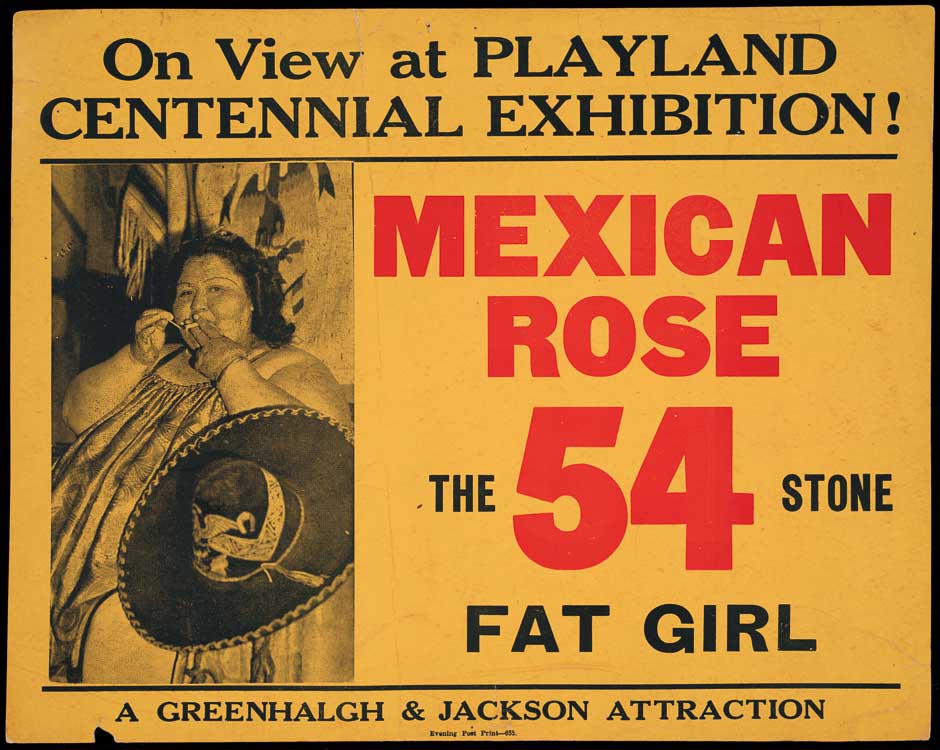
This is a poster advertising a sideshow exhibit, 'Mexican Rose the 54 stone fat girl', at the 1940 Centennial Exhibition.
More about the Mexican Rose poster
About this resource
This resource is useful because it is associated with an important national event held between November 1939 and May 1940 that:
- was attended by more than 2.6 million people, representing a daily average attendance of 17,149
- had an exhibition area covering 55 acres (22.2 hectares) of land just to the west of Wellington's airport.
It highlights how a nation emerging from a decade of economic depression viewed the centenary more as an event to do with fun and entertainment than an expression of national pride:
- The exhibition's amusement park, Playland, proved more popular with visitors than the more serious displays, the ceremonial speeches or the government department courts.
- In total, 2,870,995 people, 200,000 more than the number who visited the exhibition, spent their pounds and shillings in Playland.
- Mexican Rose was part of the Odditorium, which was the exhibition's freak show.
It provides a contrast with New Zealand in 1990 when a fair in Wellington to commemorate the Sesquicentennial, or 150th anniversary, closed after only two weeks with substantial financial losses due to low attendance.
New Zealand Centennial Exhibition, Wellington, Special Souvenir cover
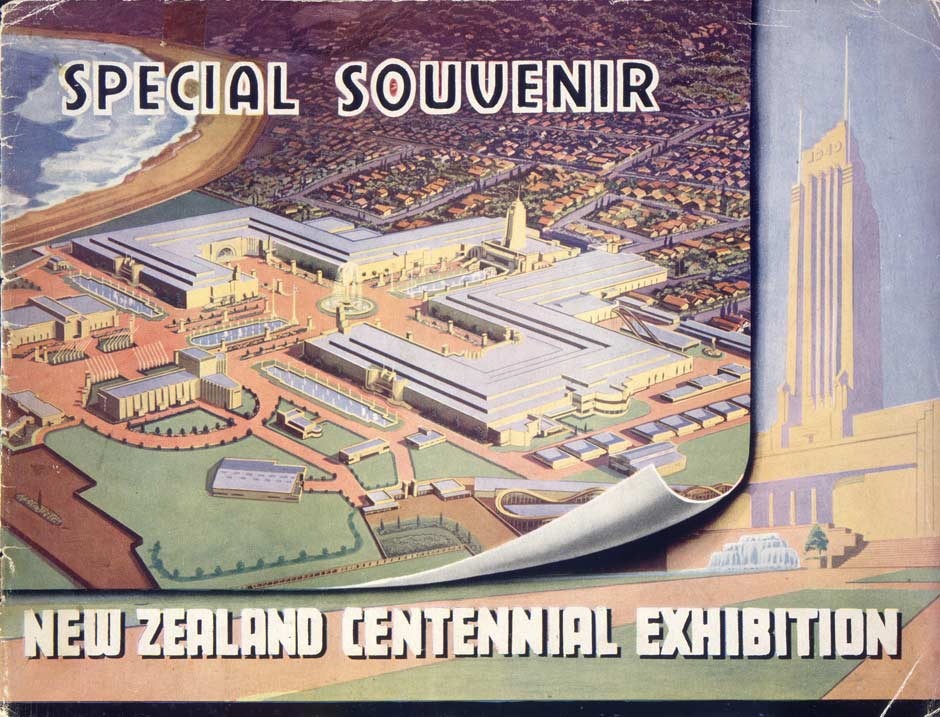
This is a cover from a souvenir booklet advertising the 1940 New Zealand Centennial Exhibition. It shows the exhibition buildings and grounds in the Wellington suburb of Rongotai. There is an additional illustration that shows the Exhibition Tower, the centerpiece of the exhibition itself.
About this resource
This resource is useful because it illustrates a deliberate act of national self-definition by the first Labour government (1935–49), with the tone of the commemorations proclaiming the Labour Party's and the country's values:
- Five years had been spent planning the event.
- A total of £75,000 (equivalent to about $6 million in today's terms) of public money had gone into it.
- The exhibition was designed to engender pride in all things Kiwi, from technological developments to social developments.
It shows what was considered to be a demonstration of the determination and ingenuity of the national spirit, as the construction of the 55 acres of exhibition buildings and grounds was achieved in a little over 22 months:
- The success of the exhibition, and the country's support of it under wartime conditions, came to symbolise the very pioneering spirit and ideals that the exhibition itself was illustrating.
- Following the outbreak of war in Europe in September 1939 the question of postponing the exhibition arose and provoked heated debate among the public and in Parliament. To fold in the face of such a challenge was considered to be against the very national characteristics that the exhibition and centennial were celebrating.
New Zealand Centennial Exhibition, Wellington, Certificate of Attendance
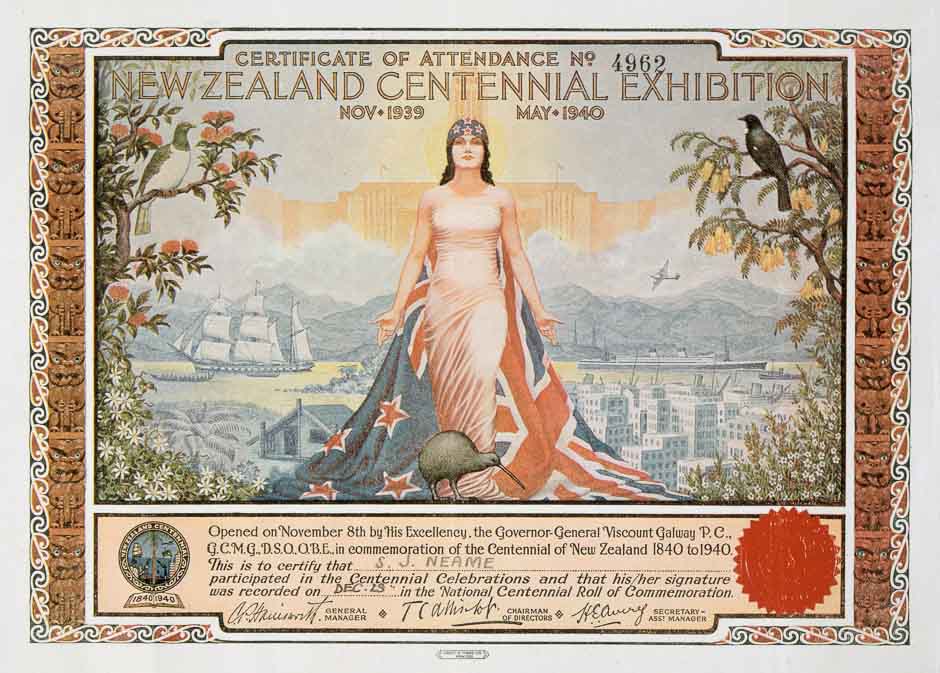
Certificate of Attendance no. 4962
This certificate was issued as proof that the recipient, in this case S. J. Neame, had attended the Centennial Exhibition. The artwork by Leonard Mitchell shows a female figure, Zealandia (a version of Britannia), partially draped in the New Zealand flag, before a montage of New Zealand scenes depicting a clear before-and-after glimpse of progress. Included in the montage are a Maori whare and waka, a sailing ship and a steamship, while an aeroplane circles the sky above the skyscrapers and cranes of a modern city. New Zealand's natural environment is expressed through the depiction of native birds such as the kereru, tui and kiwi, while native trees and plants, including a tree fern, pohutukawa, kowhai, clematis and manuka, are clearly visible. The picture is framed with Maori carving and patterns. The exhibition buildings can be seen in the background with the Exhibition Tower rising from Zealandia's head.
About this resource
This resource is useful because it highlights the way in which the centenary was portrayed as the birth of a nation, with people personified by the classical figure of Zealandia, Britannia's daughter. The before-and-after view of New Zealand, as portrayed on the certificate, has Zealandia draped in the national flag as its central piece, as if to represent the coming together of the old and the new. The strategic placement of the kiwi at her feet ensures that there can be no mistaking that this is about New Zealand.
It highlights the patriotic tone of the centenary commemorations that emphasised all that was good in New Zealand society from its flora and fauna, historical beginnings and current state of progress to its bright future. The image is symbolic of New Zealand's success in the past, present and future.
This certificate illustrates the type of propaganda produced to support and promote the ideas behind the centenary commemorations.
Using the digital learning objects and information from the feature on The 1940 Centennial complete the following activities.
1. Look at Image 1. What does this poster suggest was one aspect of the Centennial Exhibition?
2. Why would an attraction like Mexican Rose be considered a necessary part of this exhibition?
3. Was Playland in any way a celebration of New Zealand's collective culture and identity?
4. Look at Image 2. What important aims of the Centennial Exhibition are reflected in this souvenir?
5. Look at Image 3. Use this image to describe:
- how symbols and icons associated with New Zealand have been used by the artist
- why the artist has used these symbols and icons.
6. Look at Image 3. In your own words, explain what you think are some of the central themes or aims of the centenary celebrations as expressed by this certificate.
7. An important historical idea is that of continuity and change. Explain how evidence from both Image 2 and Image 3 demonstrates this idea.
8. Look at Images 1–3. Use evidence from these objects to explain ONE idea a historian might learn about the ways in which New Zealand expressed itself as a nation at this time.
-
The 1940 Centennial1
-
Cabinet briefing paper - 1940 Centennial2
-
Examining primary sources - 1940 Centennial3
-
Letter to the editor - 1940 Centennial4
-
The centenary in your area - 1940 Centennial5
-
Essay writing - 1940 Centennial6
-
The 1940 Centennial and the Treaty of Waitangi - 1940 Centennial7
-
Sound and film interpretation - 1940 Centennial8

