
Established in 1985, North Harbour is one of New Zealand’s youngest provincial rugby unions. After joining the provincial rugby elite by winning promotion to the first division in 1987, North Harbour forged a reputation for playing attractive, running rugby.
As the Auckland metropolitan area spread north of the harbour bridge there was pressure to create a new union that would give players in the area a greater chance of becoming first-class representatives. The North Harbour Rugby Union covers the area bounded by the ‘three harbours’: Mahurangi, Waitematā and Kaipara. Harbour currently plays in the professional ITM Cup. Along with Auckland and Northland, it is part of the Blues Super Rugby franchise.
Ron Williams (1985–94) and Walter Little (1987–2000) both played 145 matches for North Harbour. Warren Burton (1990–96) scored a record 1052 points for the union.
Great moments in North Harbour rugby
North Harbour has never won the top division of New Zealand’s provincial championship. Between 1993 and 1995 Harbour made three consecutive first division semi-finals. In 1994 they overwhelmed Canterbury 59–27 to earn a home final against Auckland, to whom they had lost a semi-final match the previous year. Auckland prevailed 22–16 in a rugged match at Onewa Domain, Takapuna. This was a bitter pill to swallow for the Harbour players and supporters. For Auckland, it was as if the younger sibling had been put in his place. The intensity of this match helped to establish the ‘battle of the bridge’ in the national rugby calendar.
In 1996 North Harbour was part of one of the Ranfurly Shield's most unusual seasons when they found themselves challenging for the shield three times within six weeks. Auckland lost the shield to Taranaki in their third defence of the season. Harbour, Taranaki’s first challengers, were defeated 13–11. Taranaki were then beaten by Waikato in their next defence, and as luck would have it Waikato’s next home game (and automatic defence) was against Harbour. Once more Harbour came up just short, going down 17–14 in Hamilton. Almost unbelievably they were given a third crack at the prize when Auckland defeated Waikato. This time it was literally a bridge too far with Auckland winning convincingly, 69–27.
North Harbour broke its shield hoodoo at the 11th attempt when they defeated Canterbury 21-17 in the final challenge of the 2006 season. Harbour’s hold on the shield in 2007 was all too brief. Their season began with big wins over teams from the second-tier domestic competition, the Heartland Championship. Thames Valley were dispatched 69–0 before Horowhenua-Kapiti were steam-rolled 99–6. The first serious opposition came in the form of Taranaki, who were defeated 19–13. In the next challenge things went horribly wrong. Harbour suffered the worst-ever defeat by a shield-holder, going down 52–7 to Waikato.
Buck Shelford
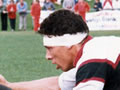
In its short history North Harbour has produced a number of distinguished All Blacks, including the iconic captain, Wayne (‘Buck’) Shelford, who is remembered as much for the ‘Bring Back Buck’ campaign that followed his dumping as All Black captain in 1990 as for his brilliance as a no. 8. Having been selected for the aborted 1985 tour of South Africa, Shelford made his test debut for the All Blacks against France in 1986 and became a casualty in the infamous ‘Battle of Nantes’. Shelford’s resilience in the face of the injuries he suffered that day endeared him to many fans at home and helped create a legend. He later described what happened:
I got kicked in the face first in a ruck and ended up spitting out various parts of 3 broken teeth. Secondly I got knocked out cold by Jean Pierre Garuet. He flew into a ruck and hit me in the right side of the forehead. I am not quite sure whether this happened after the groin or before, as I was in lala land from then on. The third incident, I was setting up a ball in a tackle zone and I believe Daniel Dubroca tried to kick the ball out of my hands, catching me in the groin. It bloody well hurt at the time, so I just chucked the old proverbial Jesus water down the shorts to make it feel better. That didn’t do a lot, so we just played on. I went off the field with 20 minutes to go not really knowing where I was, let alone what day it was. As history shows, we lost the game, and it was not until I got changed that I realised that my scrotum had been torn, and that the testicle was hanging a good 4 or 5 inches out of the scrotum. It was all put back into place and stitched up nicely.
By 1987 Shelford was clearly the best no. 8 in the country, and he played in five of New Zealand’s six matches in the triumphant World Cup campaign. After taking over the captaincy from David Kirk for the end-of-season tour to Japan, he led the All Blacks through one of their most dominant periods as they remained unbeaten between 1987 and 1990. Following the two tests against Scotland in 1990, the selectors dropped a bombshell by dropping Shelford. There was a groundswell of support for the man many believed typified all that All Black rugby was supposed to be with his tough, uncompromising play. Following defeat by Australia in the third test of the series, ‘Bring Back Buck’ signs began appearing at grounds all over the country. Talkback radio spoke of little else for a time. But the selectors never brought Buck back. Shelford was assistant coach of North Harbour in 1997 and took the lead role between 1998 and 2002.
Tell us your North Harbour rugby stories
Add your story to the Community contributions section below. We're also keen to get more regional rugby images – please email us at info@nzhistory.net.nz if you can help.
-
Regional rugby1
-
Overview2
-
Provincial competitions3
-
Northland rugby4
-
North Harbour rugby5
-
Auckland rugby6
-
Counties Manukau rugby7
-
Waikato rugby8
-
Thames Valley rugby9
-
Bay of Plenty rugby10
-
King Country rugby11
-
Taranaki rugby12
-
East Coast rugby13
-
Poverty Bay rugby14
-
Hawke's Bay rugby15
-
Whanganui rugby16
-
Manawatu rugby17
-
Horowhenua Kapiti rugby18
-
Wairarapa Bush rugby19
-
Wellington rugby20
-
Buller rugby21
-
Tasman rugby22
-
West Coast rugby23
-
Canterbury rugby24
-
Mid Canterbury rugby25
-
South Canterbury rugby26
-
North Otago rugby27
-
Otago rugby28
-
Southland rugby29
-
Best year ever?30
-
Further information31


Community contributions