
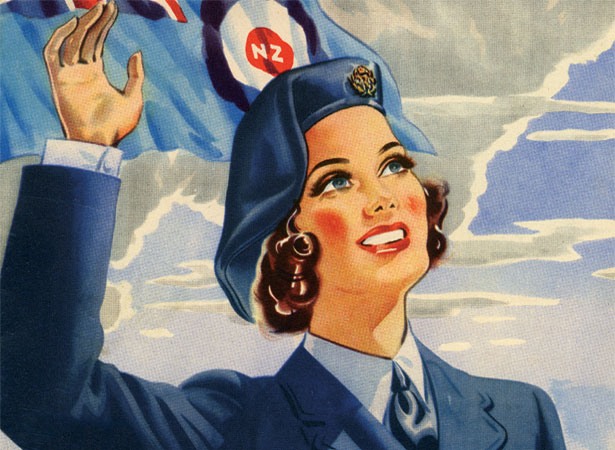
The Women’s Auxiliary Air Force (WAAF) was formed to enable the Royal New Zealand Air Force (RNZAF) to release more men for service overseas during the Second World War. Within 18 months, the authorities also created a Women’s Auxiliary Army Corps and a Women’s Royal Naval Service.
The WAAF contributed to the war effort by easing personnel shortages. Initially, women served as cooks, mess-hands, drivers, clerks, equipment assistants, medical orderlies and typists. By the end of the war, they were working in a variety of trades.
In April 1941 an initial draft of 200 women, led by Superintendent Kitty Kain, arrived at RNZAF Station Rongotai in Wellington. WAAFs went on to serve at every major air force station in New Zealand, as well as in Fiji and on Norfolk Island.
Women did not hold service ranks until 1942, when the WAAF officially joined the RNZAF. They subsequently held ranks equivalent to those of men.
At its peak in 1943, the WAAF numbered more than 3600. Approximately 4750 women passed through its ranks. More than 100 became commissioned officers, mainly in encoding and decoding work and administration.
Read more on NZHistory
Counting the cost – Second World War - overviewKitty KainOverview: 1913-1945 – Royal New Zealand Air ForceRNZAF timeline – Royal New Zealand Air Force
External links
How to cite this page
'Women's Auxiliary Air Force founded', URL: https://nzhistory.govt.nz/foundation-of-the-womens-auxiliary-air-force, (Ministry for Culture and Heritage), updated 24-Sep-2020


