
What happened that day?

Kiwi of the Week

  • te-whiti-biog.jpg

    Te Whiti-o-Rongomai

    Te Whiti was a Taranaki leader and prophet. A resistance movement based at Parihaka was led by him and Tohu Kakahi. Te Whiti was arrested following the infamous raid on Parihaka by Armed Constabulary in 1881.

This WeeK's Quiz

Today in History

1855 Massive earthquake hits Wellington region

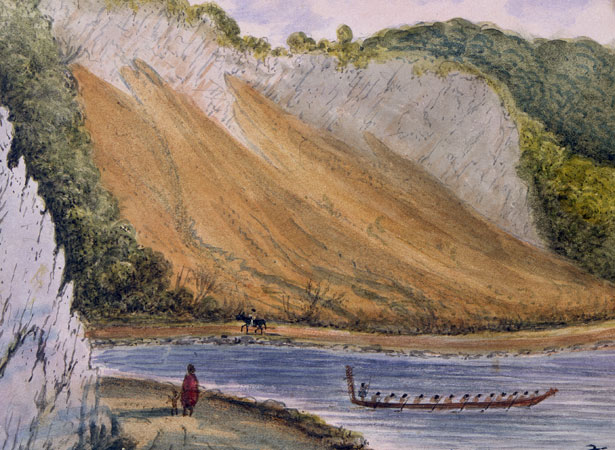
This magnitude 8.2 earthquake was to have a profound impact on the development of Wellington city. Land raised from the harbour provided much of the flat land that (combined with additional reclamations) has formed modern Wellington’s CBD.

Wellington is susceptible to earthquakes because it rests on the point where two tectonic plates meet. These plate movements have resulted in three major fault-lines running through or very close to Wellington city: the Ōhariu Fault, the Wairarapa Fault and the Wellington Fault.

The earthquake was caused by movement along a fault in Palliser Bay. It lifted the southern end of the Rimutaka Range by a staggering 6 m. About 10 minutes after the main shock a tsunami 4 m high entered Wellington Harbour, sending water surging back and forth and flooding Lambton Quay. Buildings in a Wairarapa boat harbour were washed away, a ‘gigantic wave swept the beach’ at the mouth of the Wairau River, and waves up to 30 cm high came ashore near Christchurch. The main shock was perceptible as far away as Auckland and Dunedin.

The main earthquake struck as Wellington was coming to the end of two days of celebrations to mark the 15th anniversary of its founding. The shaking began at 9.11 p.m. and lasted for 50 seconds. Panicked residents fled outdoors and remained there for the night. Many camped outside for days, and frequent aftershocks continued for months. On the 24th people as far away as New Plymouth (where chimneys were damaged by the main shock) felt continuous vibrations when sitting or leaning against walls.

A significant earthquake in 1848 had ‘more than half destroyed’ the settlement, and according to some accounts had seen many colonists turn ‘their backs permanently on Wellington’. Following this quake many buildings had been re-erected in wood. While the local council chambers and adjoining government offices, both two-storey wooden buildings, collapsed, most single-storey wooden houses survived. Many were damaged by falling brick chimneys, or shifted on their foundations, but few collapsed. Soldiers of the 65th Regiment cleared much of the debris.

The quake also helped improve communications in the region. The newly exposed strip of shoreline between Wellington and the Hutt Valley offered a safe road and (later) railway route. Previously parts of the coastal road had been impassable at high tide. Dangerous sections of the coastal route to Wairarapa were also raised. The uplift of land drained the swampy lower reaches of the Hutt Valley and gave Wellington its famous Basin Reserve cricket ground.

Despite its strength, the quake killed only a few people – one in Wellington, two in Manawatū and up to six in Wairarapa.

How to cite this page: 'Massive earthquake hits Wellington region', URL: http://www.nzhistory.net.nz/massive-earthquake-hits-wellington, (Ministry for Culture and Heritage), updated 22-Sep-2011