
These images show the Robert Scott memorial oak in Oamaru.
Memorials to Robert Falcon Scott in New Zealand
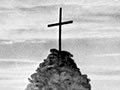
There are a number of memorials in New Zealand to British explorer Captain Robert Scott. Scott used New Zealand as a base for both the British National Antarctic Expedition in 1901-04 and the British Antarctic Expedition 1910-13. News that he and his polar party had made it to the Pole on the latter expedition, but perished on their return journey, was transmitted to the world from New Zealand in February 1913.
Oamaru
The first memorial to Scott appears to have been a marble plaque unveiled at Waitaki Boys' High School in June 1913. A memorial oak tree was also planted in Arun Street, Oamaru, overlooking the harbour. The crew members who arranged for the coded message to be sent regarding Scott's death had walked up this street to reach the local harbourmaster's residence. The memorial oak and an accompanying plaque bearing the names of the five men who died were unveiled on 28 November 1913. They are surrounded by a wrought iron fence.
More from Oamaru
The people of Oamaru also subscribed £250 for an annual memorial essay competition for Standard VI pupils at North Otago schools. In 2001 this was replaced by the Robert Falcon Scott Memorial Speech Competition.
Queenstown
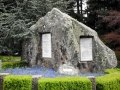
The next memorial to Scott was erected in Queenstown. The idea originated at a parade of the Queenstown cadets, who collected funds for it. Those gathered at the unveiling on 3 December 1913 included Colonel A. Bauchop, the district's commanding officer, and the Mayors of Queenstown and Invercargill. The memorial stands in the Queenstown Gardens and consists of two stone tablets attached to an immense boulder. One tablet bears the names of the five men who died, the other a paragraph from Scott's farewell message.
Port Chalmers
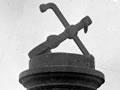
A few months later another memorial to Scott was erected at Port Chalmers, the last port he visited before his final expedition to the Antarctic. Those gathered at the unveiling on 30 May 1914 included Prime Minister William Massey, Hon. James Allen and the Mayor of Port Chalmers, T. Scollay. The memorial cairn, a tall column with a concrete anchor, was built of local stone and was designed, for free, by a local architect, Robert Arthur Burnside. Again a plaque bears the names of the five men who died. It also includes a paragraph from Scott's farewell message and a biblical passage asking, ‘What mean these stones?'. The memorial lies off Purakanui road on a rocky outcrop above the port overlooking the wharf from which Scott left.
Christchurch
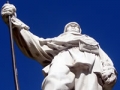
Within a week of the announcement of Scott's death the Mayor of Christchurch, Henry Holland, arranged for a committee to organise a memorial fund. They raised £1000 and entered into a contract with Lady Kathleen Scott, a sculptor by profession. They originally wanted her to construct a replica of her bronze statue of Scott, which was erected in Waterloo Place, London, in 1915. But wartime demand for bronze from armament makers meant marble was a more viable option. The statue was largely completed in early April 1916 but wartime restrictions meant it was not transported until October. It was eventually unveiled on 9 February 1917. The statue portrays Scott in polar dress and facing north on the homeward journey when death overtook him and his companions. Again a plaque bears the names of the five men who died and includes a paragraph from Scott's farewell message. It stands on the corner of Worcester St and Oxford Tce, Christchurch.
Further information
Books
- Gavin McLean, Kiwitown’s Port: the story of Oamaru’s harbour, Otago University Press, Dunedin, 2008
Links
- Scott Memorial (Otago Sculpture Trust)
- Captain Scott Memorial (Heritage New Zealand)


Community contributions