
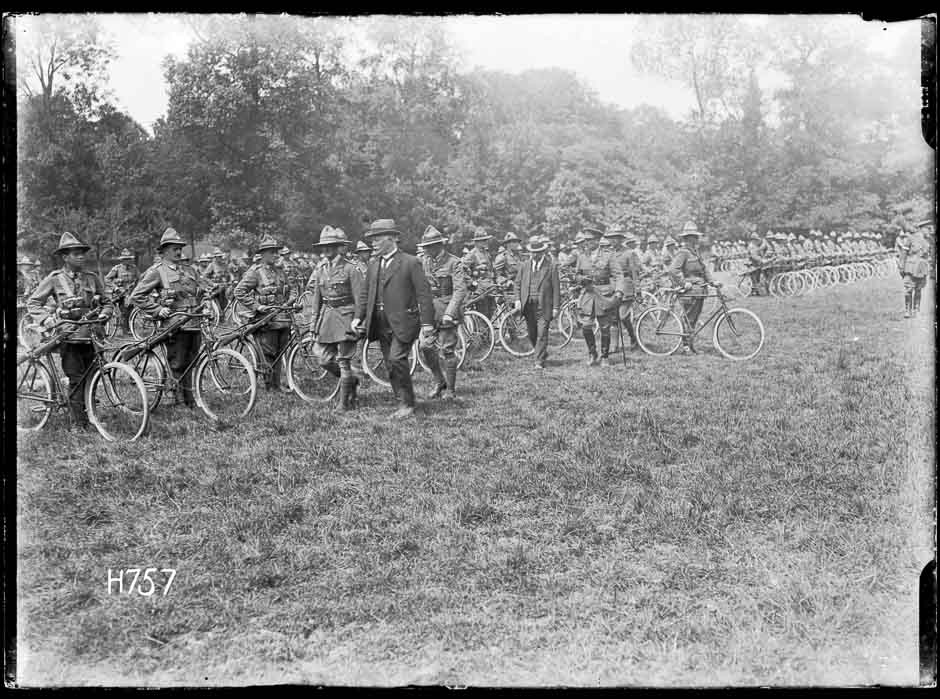
Prime Minister William Massey and Deputy Prime Minister Joseph Ward inspect the New Zealand Cyclist Corps at Oissy in northern France, 3 July 1918.
The New Zealand Cyclist Corps was created in New Zealand in March 1916 using recruits who were training to join the Mounted Rifles. Intended as mobile light infantry, the cyclists found on arrival in France in July 1916 that stationary trench warfare left them with little to do. They spent much of the war behind the lines performing tasks such as controlling traffic, laying cables and repairing trenches.
New Zealand cyclists, as part of the 2nd Anzac Cyclist Battalion, were involved in the Flanders offensives of 1917, building an 1800-m support track across no-man’s-land at Messines, and laying signal cables behind advancing troops at Gravenstafel and Bellevue Spur.
In early 1918, the New Zealand Cyclist Corps was called upon to fight as infantry, taking part in important defensive actions in the Battle of the Lys (April) and offensive actions in the Second Battle of the Marne (July-August).


Community contributions