
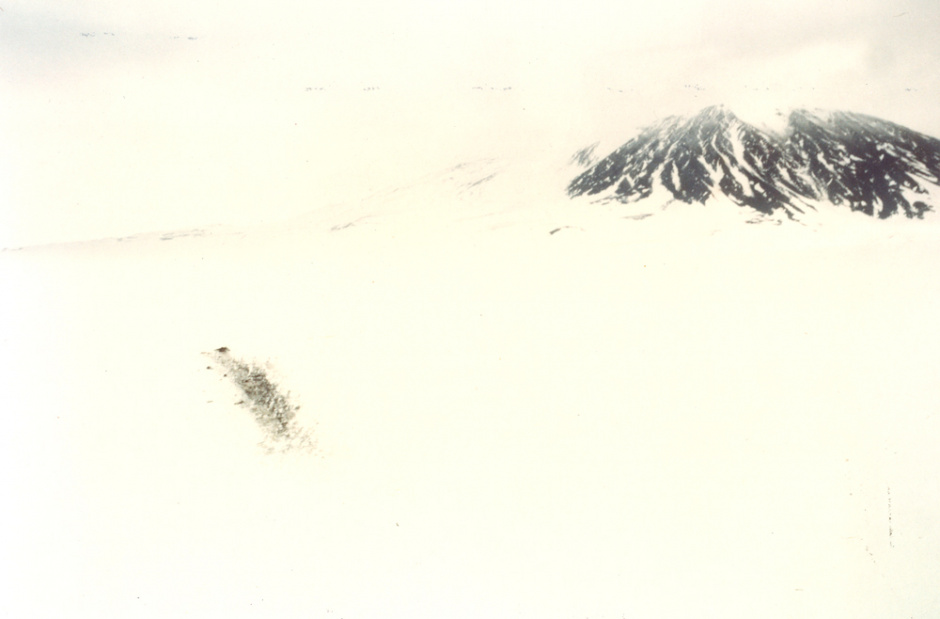
In this photograph of the crash site of Air New Zealand Flight TE901, the wreckage of the DC-10 appears as a dark smudge on the white slopes of Mt Erebus. The photo was taken by Bob Thomson during his visit to the site by helicopter on 30 November 1979, two days after the accident.
The first recovery and investigation parties
In the hours that followed the sighting of the wreckage of Air New Zealand Flight TE901, professionals and volunteers around the country learned that they were needed to head, assist or report on the site investigation and recovery operation in Antarctica. Many people stationed at Scott Base and McMurdo Station would provide invaluable assistance to the investigation and recovery parties.
The first party left from Christchurch on the afternoon of 29 November aboard a Royal New Zealand Air Force C-130. It included:
- Ron Chippindale, the chief air accident investigator, who led the site investigation. He was supported by David Graham, another investigator from the Office of Air Accidents.
- Inspector Robert (Bob) Mitchell, search and rescue coordinator, who led the recovery operation. He was supported by 10 members of the New Zealand Police's Search and Rescue and Disaster Victim Identification team.
- Five members of the Federation of New Zealand Mountain Clubs Face Rescue Squad, a group of experienced mountaineers used to operating in difficult and dangerous rescue situations.
- Ian Wood, deputy chief engineer, and Captain Ian Gemmell, chief pilot, from Air New Zealand.
- Captain Peter Rhodes, from Air New Zealand but representing the NZ Airline Pilots Association (NZALPA)
- Bob Thomson, Superintendent of the Antarctic Division of the Department of Scientific and Industrial Research.
- Paul Cavanagh and John Blumsky, journalists, and Frank Kazukaitis, cameraman, representing newspapers, radio and television.
- Bill Birch, the Minister of Science and Technology, was a late addition to the flight. He was already scheduled to visit Scott Base and the government decided that his trip should go ahead.
Disaster Victim Identification
In 1978 Chief Inspector Ian Mills and Inspector Bob Mitchell spent four months overseas studying disaster contingency planning. On their return they developed a disaster victim identification (DVI) plan, drawing on procedures used by the New South Wales Police and the FBI in the United States. The first training in this area was completed in March 1979, and there were plans to extend it throughout the country.
As the C-130 headed south, Keith Woodford, Hugh Logan and Daryl Thompson, the three New Zealand mountaineers who had been first to the crash site, and others from Scott Base, returned to erect polar tents and leave food and equipment for the coming party.
The flight arrived at McMurdo around midnight on 29 November. Mitchell, the mountaineers and others stayed at Scott Base, while the rest of police party was put up at McMurdo. Early the next morning Logan briefed the party on what they could expect at the site. He believed that only 50 to 70 bodies would be able to be recovered.
Later that morning a US Navy helicopters flew Chippindale, Mitchell and other key members of the party to the crash site. They subsequently agreed that the first priority was to get the site surveyed and establish a grid pattern that would enable the location of aircraft parts and bodies to be recorded.
Accommodation
In the aftermath of the disaster, accommodation and resources at Scott Base were stretched. Both Thomson and Scott Base leader Mike Prebble were keen that only those absolutely essential to the site investigation and recovery operation should come to Antarctica.
Members of the investigation team and their mountaineer assistants would accompany surveyors on the first flight to try to recover the digital flight data recorder (DFDR) and the cockpit voice recorder (CVR). Once the site had been surveyed and a helicopter pad established, members of the Search and Rescue and DVI team could move in to start recovering bodies and personal belongings.
The weather closed in that afternoon and no one was able to reach the crash site for the next day and a half. In the intervening period the mountaineers instructed police and investigators in rudimentary safety measures.
Part of: Operation Overdue
Next page: Site investigation begins
Further information
- The recovery operation - personal accounts from the ice (NZALPA's Erebus website)


Community contributions