
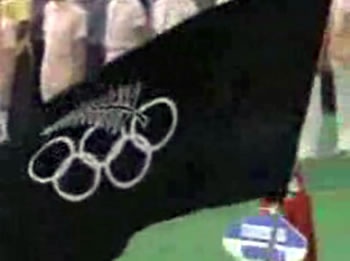
Scene from the opening ceremony of the Moscow Olympic Games, 1980. The small New Zealand team marched behind a black flag with a silver fern rather than the national flag.
Boycotting Moscow
In late December 1979 Soviet troops entered Afghanistan to prop up the government it had helped instal in Kabul eight months earlier. In retaliation, US President Jimmy Carter and British Prime Minister Margaret Thatcher instigated a boycott of the 1980 Moscow Olympics. This became larger than that led by black African nations in 1976. While New Zealand was among the 80 countries eventually represented at Moscow, its tiny team had few realistic medal prospects.
From January 1980 Robert Muldoon’s government pressured the Olympic and Commonwealth Games Association to boycott the Games. The Association delayed confirming its attendance, but by mid-April had named a team of over 100. In response Cabinet voted that there would be no official government presence or Olympic brochure, and that public servants would not be granted special leave to attend. The latter had a significant impact on some athletes. Although they could still apply for annual leave, some were told they would lose their jobs if they attended the Olympics. Others were hauled in front of their departmental head or minister and advised of the government’s position.
There was also indirect pressure on athletes and their associations, many of which feared losing future government funding or the withdrawal of sponsorship. The public appeared to support the government’s position and some athletes were abused or received obscene phone calls. Following anonymous death threats against athletes from a shadowy ‘Patriotic New Zealanders Organisation’, the police advised team members on how to handle ‘suspect mail’.
By the end of May all that remained of the Olympic team was canoeists Ian Ferguson, Alan Thompson and Geoff Walker, and modern pentathlete Brian Newth. Rather than marching behind the national flag at the opening ceremony, the small team walked behind a black flag with a silver fern. One American journalist mistakenly suggested that this symbolised New Zealand’s protest against Soviet invention in Afghanistan. He was quickly corrected by an Australian journalist, who told him that black was ‘traditional rather than a protest'.
Among the athletes to miss out was the 1976 star, John Walker. His great rival in the 1500 m, Filbert Bayi, who had himself been unable to compete in Montreal because of a boycott, commented that he missed his old sparring partner. But he added, ‘Now he knows what I felt like in 1976. It’s the same situation in reverse’.
It was not only athletes who suffered. Up to 200 New Zealanders travelled to Moscow for the Olympics, but few saw any Kiwis in action. Prior to the Games, travel agents had organised tickets for track and field, swimming and rowing. Canoeing and modern pentathlon were sold out by the time it became clear which events New Zealanders were competing in.
Brian Newth had problems with his pistol and finished 14th of the 40 competitors in the modern pentathlon, a combination of equestrian, fencing, shooting, swimming and cross-country running. The heat went on the canoeists to prevent New Zealand’s first medal drought since 1948. They too faced difficulties when one of the boats they had leased arrived from Britain without one of its seats. Next day the Russians provided two brand new boats. The canoeists didn’t win a medal but made three out of their four finals. At the following Games, canoeists Ian Ferguson, Alan Thompson, Paul MacDonald and Grant Bramwell won four gold medals.
Many athletes were bitterly disappointed at not being able to compete in Moscow, particularly as the boycott had little practical effect on Soviet policy towards Afghanistan. Its most tangible outcome was probably the ‘tit for tat’ Soviet-led boycott of the 1984 Los Angeles Olympics.


Community contributions