
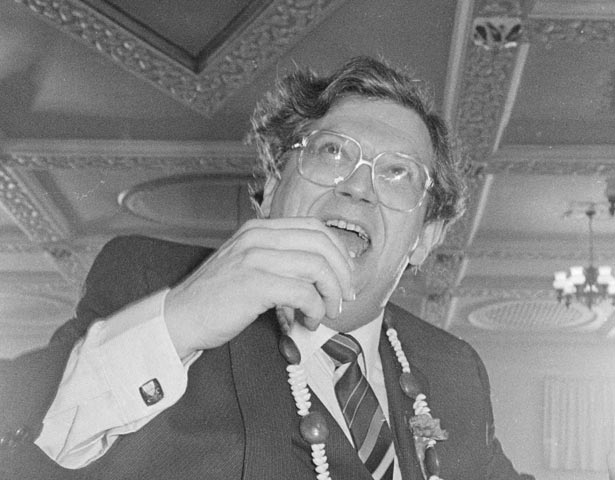
Seven years and one stomach-stapling operation after entering Parliament in 1977, David Lange became PM a week before his 42nd birthday.
The baby-boomers had ousted Robert Muldoon’s RSA generation and Lange’s youthful Cabinet ‘heaved and bubbled like a Rotorua mud pool with new ideas, some equally volcanic.’
The son of a Christian socialist doctor, Lange got through university by working at the freezing works. He described himself as a lawyer who had ‘adventures in smart-alec advocacy.’
Obese, scruffy, but brilliantly witty, Lange re-energised a caucus that was still recovering from its 1975 thrashing. In 1983, by now slimmer and better presented, he replaced Bill Rowling. Two years later he defeated Muldoon. In 1987 he achieved a goal that had eluded Labour PMs since the 1940s – a second term. His press conferences sparkled with wit and humour. He let off steam by driving rally cars.
As minister of foreign affairs, Lange championed Labour’s anti-nuclear policy. He enhanced his international reputation with a masterful performance in the widely televised Oxford Union debate in March 1985. Arguing that ‘nuclear weapons are morally indefensible’, Lange drew thunderous applause with his now famous reply to a young conservative: ‘hold your breath just for a moment. I can smell the uranium on it as you lean toward me!’ In his second term he took the education portfolio and oversaw ‘Tomorrow’s Schools’, which decentralised educational decision-making.
It seemed like a revolution. Labour made gay sex legal, gave te reo Māori official status, let the Waitangi Tribunal consider historical claims, removed subsidies, tore down tariff barriers, reformed local government, trimmed and restructured the public service and sold state assets.
But the mounting social cost of ‘Rogernomics’ (as Roger Douglas’s neo-liberal economics was known) unsettled Lange. In turn, he destablised his own government by taking unilateral positions on tax and on foreign affairs. After losing control of Cabinet, he resigned in August 1989. He sat out Labour’s difficult last months as attorney-general.
In 1992 Lange, now divorced from wife Naomi, married his former speechwriter, Margaret Pope. Four years later he left Parliament. His later years were complicated by health problems, financial worries and alcohol, but they also brought love and a new family.
By Gavin McLean
Further information:
How to cite this page
'David Lange', URL: https://nzhistory.govt.nz/people/david-lange, (Ministry for Culture and Heritage), updated 8-Nov-2017


Community contributions