
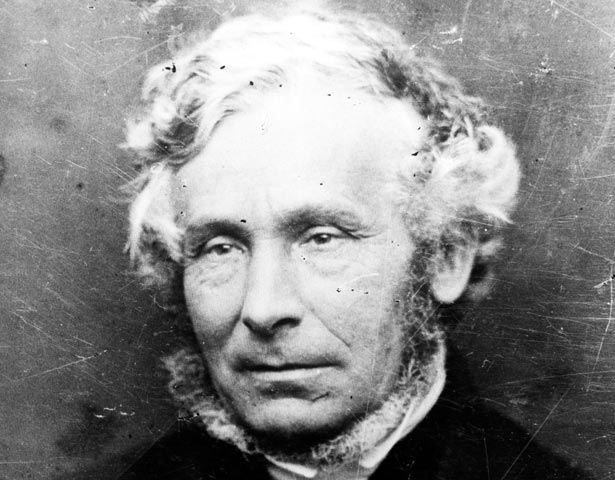
Richard Taylor (1805–1873) was ordained as an Anglican priest in 1829. He was later appointed a missionary with the Church Missionary Society (CMS), and settled at the Bay of Islands in 1839.
In January 1840 he acquired a large tract of land in the far north – including Cape Reinga and Spirits Bay/Kapowairua – from the Kaitāia chief Nōpera Pana-kareao. His main purpose appears to have been to create a permanent endowment for the local tribe, Te Aupōuri, but he was heavily criticised by those who did not appreciate his motives.
Taylor took part in the Treaty discussions at Waitangi in February 1840, and attended Treaty signings at Hokianga and Kaitāia. In 1843 he was transferred to Whanganui. His area of responsibility stretched inland as far as Taupō. He was kept busy travelling around this vast district, preaching the Gospel and attempting to keep the peace among Māori, and between Māori and settlers. He never spoke Māori fluently, but this does not seem to have lessened his influence. By the early 1850s as many as two-thirds of the Māori population in his district had been baptised, and many churches were built. He also encouraged Māori to set up their own system of justice, and to grow crops and build flour mills.
Taylor was close to Governor Grey and other officials such as Donald McLean and Lieutenant-Governor Eyre. He took part in non-religious matters, including the purchase of Māori land and the decision to send troops to Whanganui in 1845. Because of his conflicting roles as evangelist, peacemaker, and advisor to the government, he gradually had less influence over Māori. He tried and failed to negotiate a solution to the Taranaki conflict. He subsequently handed over the running of his Whanganui mission to his son, Basil.
Adapated from the DNZB biography by J. M. R. Owens
How to cite this page
'Richard Taylor', URL: https://nzhistory.govt.nz/people/richard-taylor, (Ministry for Culture and Heritage), updated 8-Nov-2017


Community contributions