
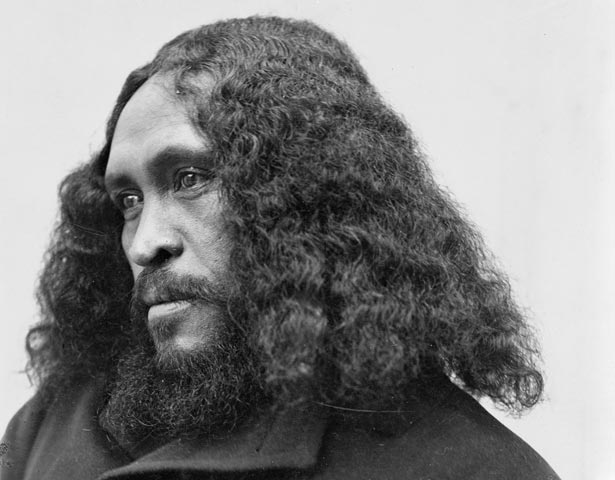
Rua Kēnana, of Ngāi Tūhoe, was born in 1868 or 1869. When Te Kooti died in 1893 he claimed to be the successor named Hepetipa (Hephzibah) whom Te Kooti had prophesied would complete his work by regaining the land.
His claims divided the Ringatū Church founded by Te Kooti. Many Tūhoe saw Rua as a symbol of a new era in which their lost lands would be returned and kept in their name. In 1907 he built a new religious community at the foot of Maungapōhatu, the mountain sacred to Tūhoe.
In 1910 Rua sold 40,000 acres (16,000 ha) of Tūhoe land for £31,000 (equivalent to nearly $5 million in 2011). He planned to use this money to develop his community at Maungapōhatu. He also hoped that roads and railways would make it economically viable. None of this happened. People in the settlement continued to die because of harsh winters, poor diet and poor housing. By 1913 Rua’s community had declined from 500–600 people to about 30 families.
The government was suspicious of Rua, and the Tohunga Suppression Act 1907 was aimed mainly at him. When the First World War broke out, he was accused of sedition because he had pacifist beliefs and opposed conscription of Māori into the armed forces. The government harassed Rua, using liquor laws to arrest him for selling illicit alcohol at Maungapōhatu. He refused to attend court, claiming he was busy with a harvest. Later he declined to accompany policemen who came to arrest him.
In April 1916 a large force of heavily armed constables was sent to arrest him. After a shot rang out two Māori, including Rua’s son, were killed in the subsequent exchange of fire. The historian Judith Binney stated that the police later manipulated the evidence to make it appear that Māori, planning an ambush, had fired first. Binney concluded that the ‘weight of evidence’ supported Rua and his followers’ denial of this version of events; in fact, one of the Māori who died might have been shot in cold blood. The way in which the arrest warrant was executed was later found to be highly questionable, if not illegal.
Rua’s trial in the Supreme Court was one of the longest in New Zealand history. Found not guilty of sedition but guilty of resisting arrest, he was sentenced to one year’s hard labour followed by 18 months’ imprisonment. The presiding officer, Judge Chapman, commented that Māori needed to learn that the law ‘reached every corner’ of the land. Eight members of the jury later publicly protested against the harshness of this sentence.
Rua returned to Maungapōhatu after his release in 1918. In 1922 Tūhoe exchanged 40,000 acres (16,000 ha) of land for a government promise to build roads connecting the settlement with the eastern Bay of Plenty and Rotorua. The roads were never built, although some compensation was paid in the 1950s. Maungapōhatu could not survive economically, and by 1930 most of the people had left. Rua died in 1937.
Adapted from the DNZB biography by Judith Binney
Rua Kēnana
Nō te tau 1868, 1869 rānei ka whānau mai a Rua Kēnana. Ko Ngāi Tūhoe tōna iwi. I te matenga o Te Kooti i te tau 1893 ka waiho tana kupu e mea ana ka haere ake he Tangata ki te whakatutuki i ana mahi kia hoki mai ngā whenua. Ki a Rua, ko ia tonu taua tangata.
I tēnei kōrero āna ka tōtara wāhi rua te Hāhi Ringatū nā Te Kooti i hanga. Nui te iwi o Ngāi Tūhoe ka whakapono ki a Rua me tana kī ka hoki mai ngā whenua ki raro i te mana o te iwi. I te tau 1907 ka hangaia e Rua tōna hapori ki te take o Maungapōhatu, te maunga tapu o te iwi.
I te tau 1910 ka hokona e Rua te 40,000 eka (16,000 heketea) o ngā whenua o Tūhoe mō te 31,000 pāuna, hei whakatipu i tōna pokapū i Maungapōhatu. Ko tana tūmanako, ka tae te rori me te rerewē ki reira. Hauwarea tērā tūmanako. Ka matemate ana pononga i te takurua, i te kore kai tika, i te kino o te āhua o ngā whare. Tatū ki te tau 1913 kua heke te rahi i Maungapōhatu mai i te 500-600 ki ngā whānau e 30 pea.
Kāore te kāwanatanga i pai ki a Rua. I te tau 1907 ka whakamanatia te Ture Whakamutu Tohunga, e hāngai tika ana ki a ia. I te tīmatanga o te Pakanga Tuatahi o te Ao, i whiua te whakapae he whana i te mana o te kāwanatanga tana mahi i tana kore i whakaae ki te tuku i ana tāngata ki te pakanga. Kāore i mutu te tutetute a te kāwanatanga i a ia. Ka whakapae te kāwanatanga kei te hoko waipiro a Rua i Maungapōhatu kāore nei ōna raihana hoko i taua kai. Kāore ia i tae ki te kōti i te wā i karangahia ai, ko te wā o te mahi kai hoki. Ka tonoa ētahi pirihimana ki te mau i a ia; engari kāore ia i haere.
I te Āperira o te tau 1916 ka whakaekea a Maungapōhatu e te ope nui o ngā pirihimana mau pū, i whakahaua kia haere ki te mauhere i a Rua. Ka pakū te pū o wai rā ka rere tēnā ki tāna pū, tēnā ki tāna pū. E rua ngā Māori i mate, ko tētahi ko te tama a Rua. E ai ki te tumu kōrero a Judith Binney, ka rāwekeweke ngā pirihimana i ngā taunakitanga, ka whakapae rātou nā ngā Māori te pakū tuatahi i tuku. Whakahē ana a Rua me ana pononga i tēnei. E ai ki a Binney, kei te tohu te rahi rawa atu o ngā taunakitanga ki te tika o te taha Māori. I tua atu, hei ko tāna, te āhua nei i āta whakamatea tētahi o ngā Māori. Nō muri ka nui ngā pātai mō te tika me te mana ā-ture o ngā whakaaetanga mō te whakaeke i a Maungapōhatu.
Ko te whakawākanga o Rua i te Kōti Matua tētahi o ngā whakawākanga roa rawa atu ki Aotearoa. Kāore i eke ngā whakapae mōna he whana i te mana o te kāwanatanga, heoi, ka whakaaetia te whakapae mō tana kore haere me ngā pirihimana i tō rātou haerenga atu ki te mau atu i a ia ki te whare herehere. Ka utaina te kotahi tau e mahi ana i ngā mahi taumaha, mutu ana tērā ko te 18 marama ki te whare herehere. E ai ki te kaiwhakawā o te kōti a Hapimana (Judge Chapman), me ako ngā Māori ki te horapa o te ture. Nō muri ka whakahēhia e te tokowaru o te hunga whakawā te whakataunga a Hapimana.
I te tau 1918 ka hoki a Rua ki Maungapōhatu. Tae ana ki te tau 1922 ka whakawhitia e Ngāi Tūhoe ōna whenua e 40,000 eka (16,00 heketea) i runga i te kī taurangi a te kāwanatanga ka whakatakotoria tētahi rori atu i Maungapōhatu ki ngā rohe o Te Moana a Toi me Rotorua. Kāore he rori, engari ka utua he paremata i te tekau tau atu i 1950. Ka heke haere, ka heke haere te ora o te kāinga o Rua i Maungapōhatu; tae ana ki te tau 1930 kua haere kē te nuinga o ngā tāngata. Nō te tau 1937 ka mate a Rua.
How to cite this page
'Rua Kēnana', URL: https://nzhistory.govt.nz/people/rua-kenana, (Ministry for Culture and Heritage), updated 21-Mar-2023


Community contributions