
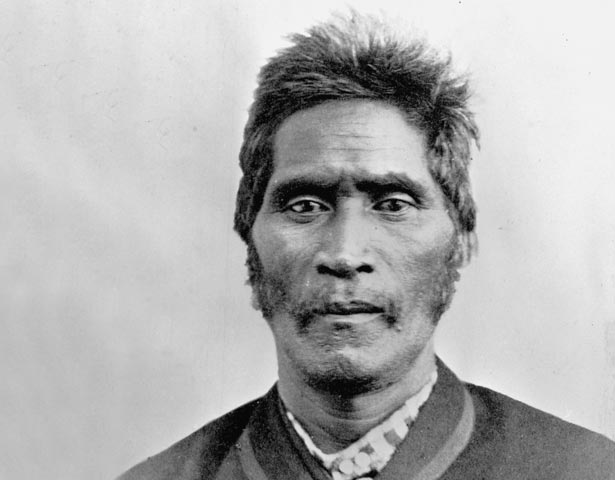
Tāmihana, born around 1805, was of Ngāti Hauā, of the Tainui confederation. As a young man he took part in several war expeditions. Through the influence of A.N. Brown, a Church Missionary Society missionary at Matamata, he quickly learned to read and write in Māori.
After his father died in 1838 he became an influential chief of his tribe, and later resisted pressure to continue fighting with neighbouring tribes. He practised Christian beliefs, within a traditional Māori framework.
In 1838 he began building a new village at Te Tāpiri. The rules of the settlement followed the Ten Commandments, and by 1839 about 300 people lived there. The church at Te Tāpiri was said to hold 1,000 people. A number of Waikato chiefs signed the Treaty of Waitangi in 1840, but Tāmihana and several others did not, although they were not hostile towards settlers.
In the early 1850s Tāmihana established another Christian settlement at Pēria. It included a post office, school house and flour mill, and was administered by a rūnanga (tribal committee or council). It soon became busy and prosperous. John Gorst, the Waikato Civil Commissioner, was particularly impressed with Ngāti Hauā social and political organisation, which he attributed to Tāmihana's influence.
Like many other Māori, Tāmihana became concerned at growing European encroachment, land sales, and the government's failure to support Māori social and political structures. He believed that a pan-tribal movement - uniting all tribes - would not only protect against European settlement, but also develop its own system of laws and maintain peace among the tribes. Tāmihana took a leading role in forming the King Movement (Kīngitanga) and the election of Pōtatau Te Wherowhero as the first Māori King. Accordingly he became known as ‘Kingmaker’. When Te Wherowhero was confirmed as King in May 1859, Tāmihana placed a Bible over his head. This became a ritual which Tāmihana's descendants still perform.
Tāmihana became deeply involved in the King Movement, and helped set up a Māori-language newspaper. When war broke out in Taranaki in 1860 he acted as mediator. But the government remained suspicious of his motives, and hostile to the Kīngitanga. Some Waikato men fought alongside the Taranaki ‘rebels’, although Tāmihana and others tried to dissuade them. Governor Browne seized on this to accuse Waikato of violating the Treaty of Waitangi, and demanded their submission. In reply, Tāmihana wrote that the King Movement did not conflict with the British Queen's authority: King and Queen could exist together, with God over both.
In 1863 Governor Grey ordered a British army to cross the Mangatāwhiri River and invade the lands of the Kīngitanga. A number of hard-fought battles followed as the skillfully prepared Māori defensive lines were overwhelmed or outflanked. Fighting did not end until the Waikato tribes withdrew into Ngāti Maniapoto territory - which became known as the King Country. The conflict then moved to Tauranga. Tāmihana took a leading role in seeking redress in the wake of the war and the massive land loss that followed. He died in 1866.
Tāmihana was a remarkable man, whose vision of peace and prosperity for his people was disrupted by a conflict not of his making.
Adapted from the DNZB biography by Evelyn Stokes
Wiremu Tāmihana Tarapipipi Te Waharoa (the 'Kingmaker')
I whānau mai a Tāmihana i te takiwā o te tau 1805. Ko Ngāti Hauā te iwi, ko Tainui te waka. I tana ohinga ka kuhuna ia ki ngā ope taua o tōna iwi. He mihinare a A. N. Brown nā te Rōpū Hāhi Mihinare. Ka mahi ia ki Matamata. Nāna a Tāmihana i ako ki te pānui me te tuhi i roto i te reo.
I te matenga o tōna matua i te tau 1838 ka nui ake te tūranga o Tāmihana. Whāia, ka ātete ia i ngā whakahau kia kawea te riri ki ngā iwi noho tata. Ahakoa tana huri hei Karaitiana, i ū tonu ia ki tōna ao Māori.
I te tau 1838 ka tīmata tana hanga kāinga hou ki Te Tāpiri. Ka whai ngā ture o tōna kāinga i ngā Whakahau Tekau. Tatū rawa ki te tau 1839, e 300 tāngata e noho ana i reira. E ai ki ngā kōrero, ka taea e te whare karakia o Te Tāpiri te 1000 tāngata. I haina ētahi o ngā rangatira o Waikato i te Tiriti o Waitangi, engari anō a Tamihana me ētahi atu, ahakoa tō ratou ngākau mārie ki ngā tāngata whai.
I te tekau tau atu i 1850 ka whakatūria e Tāmihana tētahi atu kāinga Karaitiana ki Pēria. He poutāpeta, he whare kura, he mira wīti ki reira, ā, ko te rūnanga te kaiwhakahaere o te kāinga. Kāore i roa ka hua te pai ki Pēria. Ka mihi a Te Koohi, te Kaiwhakahaere Kāwanatanga ki Waikato, mō ngā whakahaere pāpori, tōrangapū o Ngāti Hauā; hei tā Te Koohi, nā Tāmihana tēnei mahi.
Pērā i te tini o te iwi Māori, ka āwangawanga a Tāmihana mō te horapa o te Pākehā me tōna ao, ngā hoko whenua, te kore tautoko a te kāwanatanga i te noho me ngā whakahaere a te Māori. Ka whakapono a Tāmihana mā te kotahitanga o ngā iwi e ārai atu i te noho a te Pākehā; mā konā anō hoki e tau ai te rangimārie ki waenganui i ngā iwi. Ko Tāmihana tētahi i whai wāhi nui ki te hangatanga o te Kīngitanga me te whakatūnga o Pōtatau Te Wherowhero hei Kīngi Māori tuatahi. Whai anō mōhiotia ai ia ko te “Kaihanga Kīngi”. I te whakawahiatanga o Te Wherowhero hei Kīngi i te marama o Mei o te tau 1859, ka meahia e Tāmihana tētahi Paipera ki runga i te ūpoko o Te Wherowhero. Tatū ki tēnei rā, kei te kawea tonuhia taua tikanga e ngā uri whakaheke o Tāmihana.
Ka pau te kaha o Tāmihana ki te Kīngitanga. Nāna i awhi kia whakatūria tētahi nūpepa reo Māori. I te tau 1860 ka pakaru te riri ki Taranaki, ka haere a Tāmihana hei takawaenga. Heoi, kāore te kāwanatanga i te tino whakapono ki tēnei, ka whakakeke kē ki te Kīngitanga. Ahakoa ngā whakahau a Tāmihana mā, ka kuhu ētahi o ngā toa o Waikato ki te awhi i te hunga “whakakeke” o Taranaki. Tere tonu te whakapae a Kāwana Browne kei te takahi a Waikato i te Tiriti o Waitangi; ko tana tono tērā kia tuku rātou ki raro. Ko te whakautu a Tāmihana ki tēnei, kāore he tukituki o te Kīngitanga ki te mana o te Kuini o Peretānia: taea rawatia te mahi tahi a te Kīngi me te Kuini i raro i te maru o Ihowa o ngā mano.
I te tau 1863, i runga i te whakahau a Kāwana Kerei, ka whakawhiti ngā hōia o Peretānia i te awa o Mangatāwhiri, ka kuhu i ngā whenua kei raro i te mana o te Kīngitanga. Ahakoa ōna pā maioro me te tohungatanga o te Māori ki te hanga parepare, taea ai e ngā hōia te whakaeke, te karapoti rānei i a rātou. Kia rere rā anō ngā iwi o Waikato ki te Rohe Pōtae, kātahi anō ka marewa te riri. Kātahi ka kawea te riri ki roto o Tauranga. I te mutunga, ka pau te kaha o Tāmihana ki te whai paremata mō ngā whenua i raupatutia. Ka mate ia i te tau 1866.
Kātahi tētahi tangata ko Tāmihana; ahakoa tana matawhānui, nā te riri i kawea e tētahi atu, kāore i tutuki ōna tūmanako mō tōna iwi.
How to cite this page
'Wiremu Tāmihana Tarapipipi Te Waharoa ', URL: https://nzhistory.govt.nz/people/wiremu-tamihana-tarapipipi-te-waharoa, (Ministry for Culture and Heritage), updated 9-Apr-2019


Community contributions