
Rugby in 1888
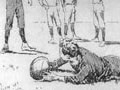
The rugby played by the Natives was not the game we know today. Tries were worth only one point, conversions two, and penalties, dropped goals and goals from a mark three. The game had evolved only partially from its original form, which had concentrated on kicking (the ball, or – more often – opponents’ shins) and ‘scrimmaging’ (something like today’s mauling).
In the late nineteenth century, back play was still in its infancy. The sport was based on rushes by groups of forwards with the ball at their feet. Backs were ‘those players who stand at the back of the real action – very handy at times in their own manner, but not really of the essence of the game’. They were more often defenders willing to hurl themselves at the feet of charging forwards than they were ball-passing attackers. Until the 1880s, the New Zealand interpretation of the rules was that forwards who heeled the ball back in the modern fashion put themselves offside. This made structured backline moves impossible.
Modern Māori rugby has been praised for the quality of its back play, and this reputation can be traced back to the Natives. Like many later New Zealand teams, their strength was at first seen to be in the forwards, where they used eight players rather than the customary nine. They also utilised specialist positions instead of packing down whoever arrived on the spot first.
Early in the tour the Natives were criticised for not passing the ball enough. Thomas Ellison, who was to captain the first official New Zealand team in Australia in 1893 and write New Zealand’s first coaching manual (The Art of Rugby Football, Wellington, 1902), in turn accused the British of ‘hooking, heeling out and passing all day long whether successful at it or not’.
But when the Natives toured New Zealand on their return from Britain, winning seven of their eight matches, they were praised for their ability to pass ‘with remarkable accuracy and quickness between their legs, over their shoulders, under their arms and with their feet’; ‘the dodging and fending powers of nearly every one, non plussed their opponents’. It seems that British lessons had been learned, at least temporarily.
Masculinity and nineteenth-century sport
How did organised sports like rugby begin? During the nineteenth century, the anarchic and violent games that had been played between villages or parts of towns in Europe at specific times of the year since the Middle Ages were tamed into more disciplined forms.
This development owed something to the desire of industrialists to improve work discipline and productivity by reforming play. Attempts were made to organise ‘rational recreation’ under a middle-class control which often embraced a new and more muscular version of Christianity.
Reformers saw football, for example, as superior to cockfighting, especially when it was played on purpose-built fields rather than on the streets. Football could help to separate potentially ‘respectable’ working men from the ‘dangerous classes’ who were seen as threatening the established order of society. In practice, however, new games often became outlets for new expressions of an old sense of communal loyalty.
Most of the sports of the Victorian era were exclusively male. Men employed in offices and factories wanted to express themselves physically outside work. They were increasingly able to do so as working hours were regularised. Sport paralleled the sexual division of labour.
The sports played by men embodied masculine qualities such as physical strength, stamina, teamwork, and craftiness in bending social rules to near breaking point. Jock Phillips has argued (A man’s country?, Auckland, 1987) that in New Zealand rugby was the ideal recreational activity through which such frontier values could be expressed long after the frontier itself had disappeared. It was inconceivable that women might want to express any similar qualities.
Men’s dedication of time, space and money to recreational pursuits was an expression of male power. Men were free to play sport rather than relate to their partners and children, and free too to take part in related gambling and drinking if they wished. The very fact that a man could openly take time off work to indulge himself with his mates showed that he was a ‘good provider’.
The playing fields of empire
In Europe, new forms of sport were also linked to the needs of expanding empires. Men who were to conquer and administer alien territories and peoples would have to be fit in both body and mind. Physical exercise channelled into pastimes with minimal risk of death or serious injury improved the body; team sports accustomed the mind to cooperating for the greater good.
In Britain, the future builders of empire were trained in public schools which encouraged the systematisation of two major sports: cricket and the various forms of football. While cricket emphasised notions of chivalry, rugby football inculcated the imperial virtues of unselfishness, fearlessness and self-control. ‘In the history of the British Empire it is written that England has owed her sovereignty to her sports’, the headmaster of Harrow proclaimed in 1895.
What of the subjects of British sovereignty? Richard Holt (Sport and the British, Oxford, 1989) claims that ‘sport played a major role in the transmission of imperial and national ideas’. Writing of cricket in particular, he argues that ‘what began as a manly exercise for a master race slowly came to be a kind of common language superficially obscuring divisions of ethnicity, religion, and economic interest’. Sport was an aspect of the ‘cultural power’ through which the British Empire imposed and maintained itself more cheaply than it could have done by military might alone.
In colonial New Zealand, rugby football rather than cricket came to perform such a function. It both encouraged loyalty to the Crown amongst white emigrants and helped assimilate a Māori elite into the ‘British way of life’.
Rugby was quickly taken up at Hawke’s Bay’s Te Aute College, a church-run boarding school for Māori boys. Six members of the Native team had been pupils at Te Aute, where the trinity of study, work and games was consciously utilised to build character. But while sport encouraged rulers and ruled to develop shared beliefs and ideas, it also underlined the social space that separated them.


