
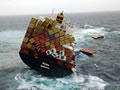
On 5 October 2011 the Mediterranean Shipping Company-chartered, Liberian-flagged container ship Rena astonished local mariners by grounding on the clearly marked Astrolabe Reef in the Bay of Plenty while approaching Tauranga Harbour. Three months later the vessel broke in half.
A salvage operation which cost $700 million – second only to the billions spent in Italy removing the cruise ship Costa Concordia – ended in April 2016 after sea conditions had frequently hampered work. Removing the rest of the wreck would cost even more than had already been spent. The owners and insurers received resource consent to leave a portion of the Rena on the reef ‘in an environmentally benign state’, but the ruling was appealed by Mōtītī iwi Te Patuwai (known as Ngāi Te Hapū) and others who wanted everything removed. This question will go to the Environment Court for a ruling in 2017. Meanwhile, the Rena has become a diving destination.
New Zealand’s biggest shipwreck?
The Rena is the largest ship ever lost in New Zealand waters. Built in 1990 as the Zim America, it was 37,209 tons gross registered tonnage and 47,000 tonnes deadweight (i.e., what it can carry). The ship was 236 m long.
The largest vessel lost here previously was the Soviet cruise ship Mikhail Lermontov, which sank in Port Gore in the Marlborough Sounds on 16 February 1986 after striking rocks while leaving Queen Charlotte Sound. The Mikhail Lermontov, built in 1972, was 22,352 tons gross and 155 m long. One crewman died, and several recreational divers have died since then while exploring the wreck.
Before that, the largest ship lost in local waters was the Canadian-Australasian Line passenger liner Niagara, sunk off the Mokohinau Islands by a German-laid mine on 19 June 1940. The ship, built in 1913, was 13,415 tons gross.
New Zealand’s costliest shipwreck?
In terms of human lives, fortunately, no. The biggest death toll in our history came with the wreck of HMS Orpheus on the Manukau bar on 7 February 1861. That cost the lives of 189 of the 250 officers and men aboard the ship.
The financial cost was undoubtedly the greatest in New Zealand history, and the ecological cost may have been. About 350 tonnes of oil was spilt, and 950 tonnes of oily waste was subsequently collected from local beaches. Eighty-seven of the 1368 containers on board were washed overboard, with the contents of many fouling the coast. Thousands of birds were killed. More damage was done when the Rena broke in half on 8 January 2012.
New Zealand’s worst environmental maritime disaster?
A week after the Rena struck Astrolabe Reef, Environment Minister Nick Smith described the stranding as New Zealand’s ‘worst maritime environmental disaster’.
Astrolabe Reef
The reef that the Rena hit is named after the French navigator Dumont D'Urville's ship, the Astrolabe, which narrowly escaped destruction here on 16 February 1827.
The only other commercial ship to have been wrecked on the reef since 1795 was the Nellie in 1878.
The same day, Radio New Zealand reported Director of Maritime New Zealand Catherine Taylor as saying that on a scale of 10, ‘the disaster rates an eight’.
The loss of the oil tanker Torrey Canyon off the British coast in the 1960s changed people’s attitude to marine pollution.
In the days of sail there was no fossil fuel to come ashore. When steam took over, those ships burned coal. When they sank off the coast the coal sank with them (and the little that was washed ashore sometimes provided beachcombers with welcome free fuel).
That changed with the switch from coal to oil firing, and especially with the more recent use of low-grade ‘bunker fuel’ by big ships. This is much thicker and more toxic than the marine diesel a boatie may accidentally spill while topping up at a marina.
And, of course, ships have got a lot bigger. When big ships get into trouble, they can spill a lot more fuel and cargo than their predecessors did.
On 12 October 2011, the Maritime New Zealand website listed these ‘significant marine oil spills in New Zealand waters since 1990’:
Don Wong 1998
The Korean fishing vessel Don Wong 529 ran aground off Stewart Island, spilling 400 tonnes of automotive oil into the ocean. Of this, 310 tonnes was dispersed either naturally or with chemicals and the other 90 tonnes was recovered by salvors.
Rotoma 1999
The container ship Rotoma discharged around 7 tonnes of oily water off the Tutukākā coast, creating an oil slick 6 km long. The ship’s owner and agent both admitted charges of discharging petroleum and failing to notify the spill, and were fined a total of $60,000.
Seafresh 1 2000
In 2000, the vessel Seafresh 1 sank off the Chatham Islands after catching fire. Divers managed to plug vents on the wreck, and only 60 tonnes of the 102 tonnes of diesel on board spilled. No harm to wildlife on the shoreline was observed.
Jody F Millennium 2002
In 2002, huge swells caused the log ship Jody F Millennium to break its moorings in Gisborne Harbour. While it was being shepherded to safety out at sea, a big wave drove the ship onto a nearby beach, where it remained stranded for 18 days. The Jody F leaked 25 tonnes of heavy fuel oil into Poverty Bay, affecting about 8 km of coastline.
Are these accidents getting more common?
Fortunately, no.
Apart from the Mikhail Lermontov, only three large overseas ships have come ashore in New Zealand in the last 30 years. All three bulk carriers, the Pacific Charger (Wellington, 1981), Jody F Millennium (Gisborne, 2002) and Tai Ping (Bluff, 2002) were successfully refloated.
Better charts, radar and more recently GPS have made our coasts much safer than they were in colonial days, when passengers and crewmen could die in their hundreds.
Read more:
- Maritime New Zealand incident pages - including an excellent gallery
- Astrolabe Reef/Otaiti
- Rena in review (SunLive)
- Rena - shipwreck that shook a nation (NZ Herald)
- New Zealand Herald's Rena oil spill interactive
- Kennedy Warne, ‘Black Tide’, New Zealand Geographic, no. 113, Jan/Feb 2012
- Kennedy Warne, ‘Disappearing Act’, New Zealand Geographic, no. 136, Nov/Dec 2015


Community contributions