
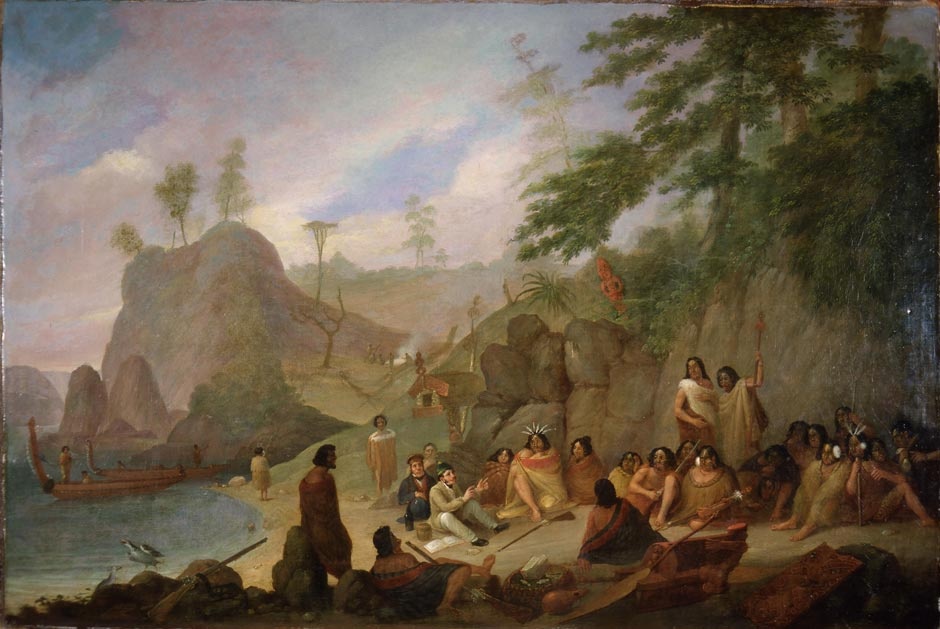
Meeting of the artist and Hongi at the Bay of Islands, November 1827, by Augustus Earle.
In this painting by Augustus Earle (1793–1838), Hongi Hika (c. 1772–1828) is seated in the centre with huia feathers in his hair. Earle, seated at left and wearing a green cap, is gesturing. Behind him is another European, his friend Shand.
This meeting took place about 2 km from Kororāreka (now Russell). Earlier in the year Hongi Hika had fought a battle at Whangaroa without wearing the armour he had been given by King George IV. Wounded in the chest by a musket ball, he was to die a few months later.
The name of Hongi Hika is synonymous with the Musket Wars, which are widely regarded as having started with the battle of Moremonui, at Maunganui Bluff on the west coast of Northland, in 1807 or 1808. The iwi (tribes) of Ngāti Whātua (from Kaipara), Te-Uri-o-Hau and Te Roroa fought Ngāpuhi in a bloody battle that was named Te Kai a te Karoro – The Seagulls’ Feast.
Because they controlled the Bay of Islands, the first major trading base for European vessels, Ngāpuhi were the first iwi to use muskets. At Moremonui they did not have many muskets and were defeated by their rivals, who were using traditional weapons. Ngāpuhi were overrun as they reloaded their cumbersome weapons and the chief Pokaia was killed. As many as a thousand Ngāpuhi warriors were hunted down and killed. The future war leaders Kawiti and Hongi Hika managed to escape, but Hongi’s uncle and two brothers were not so lucky. Hongi felt obliged to avenge this defeat. By 1815 he was the undisputed leader of his people. Convinced of the value of muskets if they were used in sufficient numbers, he set about acquiring them.


Community contributions