
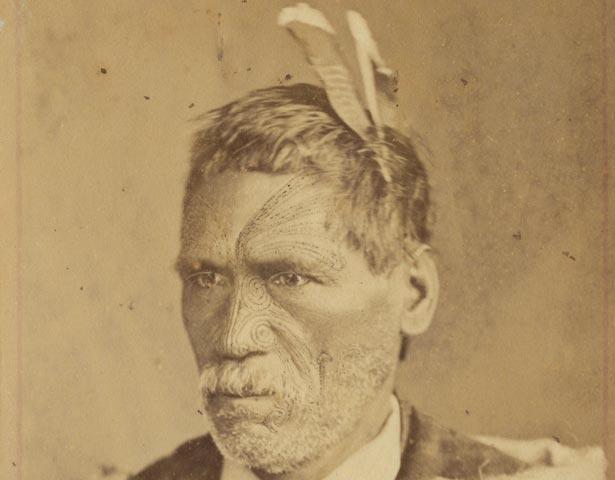
Rewi Maniapoto was of the Ngāti Paretekawa hapu (sub-tribe) of Ngāti Maniapoto. He was trained in the traditional customs of his people, and learned to read and write at the Wesleyan mission station at Te Kōpua.
In the 1850s he was a leading supporter of the King Movement. His people fought the government alongside Taranaki Māori in 1860–61. This experience convinced him that the government intended to overturn Māori rangatiratanga (authority/chieftainship) and take land at any cost. He organised the support of many among Ngāti Maniapoto and Waikato, against the views of the more moderate Kīngitanga leaders.
Rewi took a leading role in the Waikato war (1863–64). He fought with great bravery and skill despite overwhelming odds. When called upon to surrender at Orākau in 1864 he uttered the famous words, 'Ka whawhai tonu mātou, Ake! Ake! Ake! - We will fight on for ever and ever!'
After several defeats the Māori King and his Waikato followers took refuge in Ngāti Maniapoto territory, where they remained for many years. Rewi later played a key role in establishing and expanding the Rohe Pōtae (King Country). In this vast area, extending into western Taupō and upper Wanganui, the King’s authority was supreme.
By the late 1860s Rewi had come to the view that Māori could not win back their mana (authority) by force. However, they did not reach a peace agreement with the government until 1878. Ngati Maniapoto did not suffer large-scale confiscation, although Waikato Maori lost 1.2 million acres (nearly half a million hectares).
In 1882 Rewi broke with the King Movement. The King insisted that there should be no negotiations with the government until the confiscation issue had been resolved. But Rewi agreed to government surveys within the Rohe Pōtae, and discussed the construction of the main trunk railway through the King Country, in exchange for a number of concessions to the government. Rewi’s actions ultimately opened the way for extensive government purchases in the King Country, despite his attempts to control the speed and scale of land alienation. After this his influence declined, and he died in 1894.
Adapted from the DNZB biography by Manuka Henare
Rewi Manga Maniapoto
I whānau mai a Rewi Maniapoto (?-1894) ki roto i a Ngāti Paretekawa, hapū o Ngāti Maniapoto. I ākona ia ki ngā tikanga, ki ngā kōrero tuku iho o tōna iwi. Ka ako ia ki te pānui me te tuhi i te mīhana Wēteriana i Te Kōpua.
He kaha tana tautoko i te Kīngitanga i te tekau tau atu i 1850. Ka whawhai tōna iwi ki te taha o ngā iwi o Taranaki i te 1860-61. I konei ka tipu te whakaaro ki a ia, ko te hiahia o te kāwanatanga kia turakina te rangatiratanga o te Māori, e tareka ai te tango i ōna whenua. Nāna te rahi o Ngāti Maniapoto me Waikato i whakatikatika ki te tautoko i te hunga kei te whawhai ki te kāwanatanga, hāunga ngā māharahara o ētahi o ngā rangatira o te Kīngitanga.
Ko Rewi tētahi o ngā kaingārahu i ngā riri ki te riu o Waikato i ngā tau 1863, 1864. Ahakoa te tini hōia, ka hau te rongo mō te māia, te tohungatanga o Rewi ki te matawhāura. I te riri ki Ōrākau, ka tono ngā hōia kia tuku a Rewi mā i ā rātou pū ki raro. Ka whakautua e Rewi tēnei tono me te kōrero rongonui, "Ka whawhai tonu mātou. Ake! Ake! Ake!"
Ka hingahinga rā ngā taua o te Kīngitanga i ngā pakanga ki ngā hōia. Taro ake, ka rere te Kīngi Māori me tōna iwi ki te rohe o Ngāti Maniapoto whakamarumaru ai. Ka hia tau e noho ana rātou ki reira. Ko Rewi tētahi o ngā rangatira nā rātou i whakaū, i whakawhānui Te Rohe Pōtae. Ka toro tēnei rohe ki ngā tahatika o te moana o Taupō ki te uru, ki te hikuwai o te awa o Wanganui. Kāore he mana i tua atu i tō te Kīngi i tēnei rohe.
Kia tae ki te paunga o te tekau tau atu i 1860, kua kite a Rewi e kore e taea e te riri te whakahoki mai i te mana o te iwi. Heoi, nō te tau 1878 kātahi anō ka mau te rongo me te kāwanatanga. Kāore i kaha raupatutia ngā whenua o Ngāti Maniapoto, heoi 1.2 miriona eka (tata ki te haurua miriona heketea) o ngā whenua o Waikato i raupatutia.
I te tau 1882 ka maunu a Rewi i te Kīngitanga. Ko te whakahau a te Kīngi kia kaua te iwi e whitiwhiti kōrero me te kāwanatanga kia ea rā anō te take o ngā whenua i raupatutia. Heoi, ka whakaae a Rewi ki ngā rūri whenua a te kāwanatanga ki roto i te Rohe Pōtae, ka whitiwhiti kōrero hoki ia mō te whakatakoto rerewē. Hei utu mō tēnei, ka tukua e te kawanatanga ētahi painga. Nā ngā mahi a Rewi ka tuwhera te Rohe Pōtae ki ngā hokonga whenua a te kāwanatanga, ahakoa tana ngana kia āta haere ngā hokonga, kia kaua e tino nui te whenua ka hokona. Whāia, ka memeha tōna awe. Ka mate ia i te tau 1894.
How to cite this page
'Rewi Maniapoto', URL: https://nzhistory.govt.nz/people/rewi-maniapoto, (Ministry for Culture and Heritage), updated 30-Sep-2020


Community contributions