1952 ANZUS comes into force
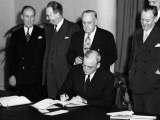
Representing Australia, New Zealand and the United States, this treaty recognised that an armed attack in the Pacific area on one member endangered the peace and safety of the others. Each signatory pledged to 'act to meet the common danger'.
When British troops surrendered to the Japanese at Singapore in February 1942 New Zealand's confidence in Britain's ability to
protect the far-flung parts of its Empire was seriously undermined. A
vulnerable New Zealand
began to look elsewhere for its security. In 1945 this country was one of 51 nations
to sign the United Nations Charter, pledging its support for the principle of
collective security. Even so, New
Zealand sought a powerful ally capable of filling Britain's
shoes.
The United States
became the dominant Pacific power in the 1940s. After the war the Americans
wanted a strong Japan as a barrier
to the spread of communism in Asia. New Zealand and Australia
worried that a resurgent Japan could again threaten the
region. In order to reassure New Zealand
and Australia about their
protection, and to enlist their support for the anti-communist cause, the ANZUS treaty was signed in 1951. Each party
agreed to maintain and develop their resources in order to strengthen their
ability to resist attack, as well as consult together if the security of any
member state was threatened in the Pacific.
ANZUS remained in force until the nuclear ships row of the mid-1980s. When the Labour
government announced its decision to ban ships that were either nuclear-powered
or armed, New Zealand was effectively
frozen out of the ANZUS treaty by the Americans.