
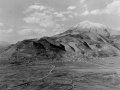
The struggle for Cassino in early 1944 was one of the most brutal and costly battles involving New Zealand forces in the Second World War. For the New Zealand Division, this German strongpoint southeast of Rome would prove the most tragically elusive prize of the Italian campaign.
The Germans' success in resisting the Allied offensive along the Gustav Line prompted the Allies to switch their focus to the Liri Valley, which led directly to Rome. However, the entrance to the valley was just over ten kilometres wide and was overlooked by the 500-metre-high Monte Cassino, topped by an historic Benedictine monastery.
A defender's dream
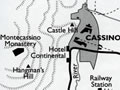
Augmented by the Germans' meticulous deployment of minefields, fortifications and flooding though demolition of stop-banks, Cassino was a defender's dream and an attacking army's nightmare. New Zealand involvement in this challenging task was in part due to the failure of the American 5th Army's attempt to bypass the German front line by staging a seaborne attack at Anzio, south of Rome. An initial attack by American forces on Cassino in January had already met with heavy losses and a failure to break through to the Liri Valley.
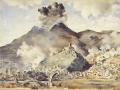
Temporarily heading a New Zealand Corps (a unit which included the New Zealand Division and the 4th Indian Division), Lieutenant-General Sir Bernard Freyberg now steeled himself and his forces for the battle ahead. Desperate to minimise casualties, he requested a massive bombardment of the German defences to precede the assault by his troops. As this included the historic monastery, the decision needed direct approval by the Supreme Allied Commander in the Mediterranean, General Sir Harold Alexander. The subsequent aerial bombardment on 15 February laid waste the monastery and its environs.
Controversy about this decision would persist long after the war was over. Tragically for the waiting New Zealand soldiers, most of the German defenders survived and exploited the ruins of the town and monastery to create an even more formidable set of defences.
The 17 February attack
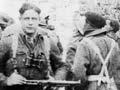
Adding to the New Zealand Corps’ woes, the aerial bombardment took place a day and a half before the corps was prepared to mount an attack. They nevertheless proceeded with the plan, which involved the Indian Division attacking Cassino from the north, while the New Zealanders were to attack the town from the south with the hope of punching an opening for the Allies into the Liri Valley. Due to the Germans’ demolition of floodbanks south of Cassino, only one New Zealand battalion was able to cross the flooded Rapido in the southern attack. It fell to the 28th (Māori) Battalion to initiate the attack on the town's well-defended railway station south of the town on 17 February.
In Freyberg's absence
The NZ Division's temporary commander at Cassino was Brigadier-General Howard Kippenberger. On 2 March 1944 he lost both his feet to an anti-personnel mine and command was transferred to Brigadier G.B. Parkinson.
After one of the fiercest and costliest battles fought by the unit during the war, men of the battalion seized positions in and around the station. But the equally courageous engineers following behind them were unable to clear a path through the flooded terrain for reinforcements. Without support, the isolated Māori soldiers were forced to withdraw after a withering counter-attack by German infantry backed by tanks. Over 150 of the Battalion's men were killed, wounded or captured in this failed attack — the first of a number of setbacks for the Division at Cassino.
Further assaults fail
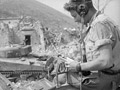
A series of other brave but unsuccessful assaults ensued. After another heavy bombardment, New Zealand forces fought their way into the devastated town from the north on 15 March. Once again, the Germans put up tenacious resistance from hidden positions in the maze of rubble that was once Cassino. In creating ideal positions for enemy snipers and hindering access for New Zealand’s armoured support, the bombing of the town had proved to be counter-productive. After eight days of fighting from one shattered building to the next, Freyberg decided the cost was proving too high and he ordered his troops to stop their attack. Shortly afterwards in early April, the New Zealand Division withdrew from the Cassino area, having suffered 343 deaths and over 600 wounded.
Cassino finally falls
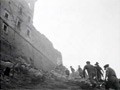
Cassino finally fell in May 1944 to British and Polish troops, with support from New Zealand artillery. The Gustav Line was at last breached. Allied forces entered Rome on 4 June, two days before the D-Day landings in Normandy. The success of the cross-channel invasion meant that the Italian campaign became a secondary theatre of operations, with seven Allied divisions redeployed to France in August 1944. The Italian campaign's main purpose was now to divert part of the German war effort and to tie down forces which might otherwise have been used to defend France and Germany itself.


