
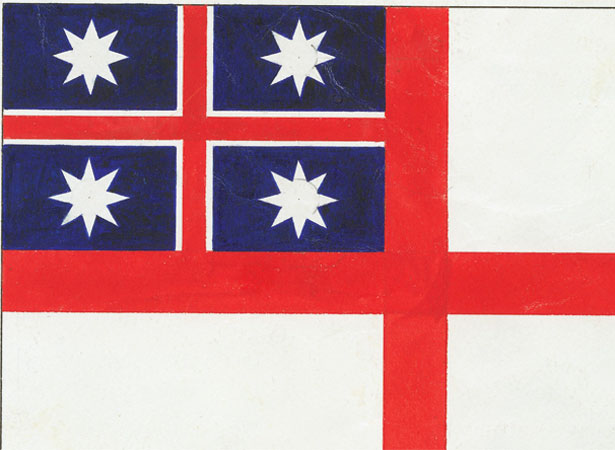
A New Zealand flag was first suggested in 1830 after Sydney customs officials seized a Hokianga-built ship.
Australia was subject to British navigation laws, under which ships had to carry official certificates. As New Zealand was not a British colony, New Zealand-built ships could not sail under a British flag or register. Without this, they and their cargoes would continue to be seized.
In 1833 British Resident James Busby suggested the adoption of a New Zealand flag. This would both solve the shipping problem and encourage Māori chiefs to work together as an embryonic collective government. Church Missionary Society (CMS) missionary Henry Williams arranged for three alternative designs to be made up in Sydney.
On 20 March 1834, 25 northern chiefs met at Waitangi to view the three flags. Many Pākehā also attended. Following an address by Busby, each chief was called forward to vote.
Their preferred design – the CMS flag – incorporated the flag of the Anglican diocese of New South Wales into the Royal Navy’s white ensign. Busby declared it the national flag of New Zealand.
Read more on NZHistory
Choosing a flag – Taming the frontierPolitical and constitutional timeline – Political and constitutional timelineUnited Tribes flag – Flags of New ZealandHistory of New Zealand, 1769-1914 – A history of New Zealand 1769-1914WaikatoTe Rēweti AtuahaereMoetara Motu TongapōrutuTāmati Wāka NeneKiwikiwiMakoare Te TaonuiEruera Pare HongiDeclaration of Independence – He Whakaputanga - Declaration of IndependenceFlags of New Zealand – Flags of New Zealand
External links
How to cite this page
'New Zealand's first recognised flag chosen', URL: https://nzhistory.govt.nz/a-flag-to-represent-new-zealand-is-chosen, (Ministry for Culture and Heritage), updated 8-Oct-2020


