

During and immediately after the Second World War the government gradually took over all the large coal mines in the Buller coalfield including Denniston, Millerton and Stockton. By 1948 there was an imaginary demarcation line along the Ngakawau River – all the mines to the south were state-owned, while those to the north were privately owned.
There was a buoyant market for coal in the late 1940s and early 1950s, and the Seddonville mines prospered. After 1956, though, demand slumped as many customers changed to oil. The smaller private mines gradually closed as they were unable to find markets for the coal they produced.
Charming Creek mine

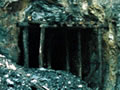
The Charming Creek mine had become one of the largest privately owned mines in the country – certainly the largest producing bituminous coal. The change to hydraulic mining allowed the mine to survive until the 1980s, although with far fewer workers. Its coal was trucked from the mine to a dump at Seddonville, and then transported by train.
In 1965 the Charming Creek mine was taken over by the Bridgevale Group (later Bridgevale Mining), a precursor of Bridgecorp. In its 1980 prospectus the company predicted a bright future, with enough coal for another 30 years.
Although coal still remains in the ground, it proved impossible to sell. Seddonville coal is characteristically high in sulfur – generally 5%, and sometimes up to 6%. With increasing environmental awareness, burning high-sulfur coal was banned in many urban areas as well as in organisations such as hospitals and schools.
The last major customer was the dairy factory at Karamea. When the mine closed in 1986 it had only four staff.
Is there any coal left?
The New Zealand Coal Resources Survey systematically evaluated all areas of coal in New Zealand in the 1980s. A detailed study of the Seddonville area, including new drilling, concluded that coal was present only as lens-like pods rather that as a continuous seam: 'The chances of discovering a major new coal deposit in the sector are extremely slim'.
There are still small patches of coal that might be mined, including some in the Charming Creek workings. But the only likelihood of future mining is if a market is found for coal that is exceptionally high in sulfur.


