
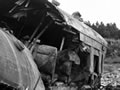
Almost everyone killed at Tangiwai was travelling in a second-class carriage – 148 out of 151. Traditionally located at the front of the train, these were more affected by the noise, smoke, coal dust and fumes of the locomotive, something those in first class paid to avoid. In a head-on collision or derailment, second-class passengers were at greater risk of death or injury. At Tangiwai, just 28 of the more than 170 second-class passengers survived. Only one first-class passenger was lost, along with the driver and fireman. Most of the passengers in the final three (first-class) carriages, which remained on the track, initially did not even know what had happened to their train.
The Tangiwai disaster was especially tragic for the Nicholls family from Palmerston North and the Benton family from Marton, which each lost five members, and the Fitzgerald family from Lower Hutt, which lost four. Amidst the death and carnage, though, there were some good-luck stories.
Seventeen-year-old Barbara Mahy and her younger brother John had first-class tickets but could only find seats in a second-class carriage. After leaving Waiōuru the guard moved them to the last first-class carriage, at the rear of the train. Almost all the occupants of their original carriage were killed. Christine Cole Catley and her three small children were booked to travel second-class that evening but due to a change of plans travelled a day earlier. For the rest of her life she wondered about ‘the people who considered themselves lucky’ to get those tickets at the last moment.
The Tangiwai tragedy killed more people than the combined total of all the other rail accidents in New Zealand history (the next-worst accidents, at Hyde in 1943 and Ōngarue in 1923, claimed 21 and 17 lives respectively). It is worth noting, too, that in 1953 road accidents in New Zealand claimed 279 lives.


