
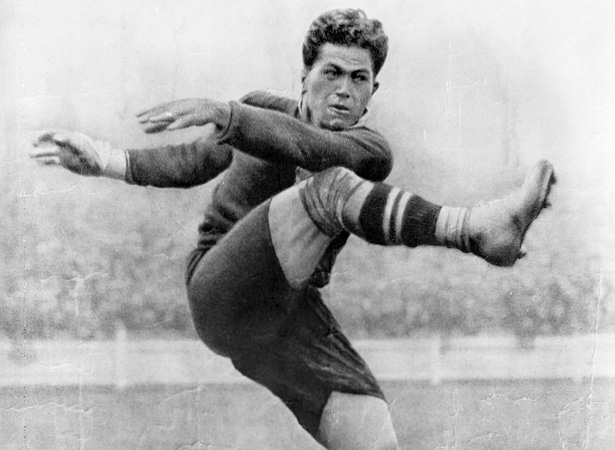
The 19-year-old fullback Nepia was one of the stars of the 1924–5 All Blacks, dubbed the ‘Invincibles’. He played in all 32 matches on the team’s tour of the British Isles, France and Canada. Still only 25, he appeared in his last test match in 1930, the final game of the home series against the British Lions. The All Blacks won the match 22–8 to clinch the series 3–1.
His performances on the 1924–5 tour prompted one leading British journalist to write, ‘it is not for me a question of whether Nepia was the best fullback in history. It is a question of which of the others is fit to loose the laces of his Cotton Oxford boots’. But after that four-test tour, Nepia only played five more test matches for the All Blacks. One reason was his non-selection, on racial grounds, for the 1928 tour of South Africa. He was also restricted by injury and was unavailable for several tours.
After suffering financial hardship during the Great Depression, Nepia moved to secure his family’s future by accepting an offer to play rugby league in Britain in the mid-1930s. He returned to New Zealand in 1937 and played in the Kiwis’ famous 16–15 win over Australia.
After the Second World War Nepia was reinstated to rugby. In 1947 he played two representative matches for East Coast. In 1950, now in his mid-40s, he played at fullback in a festival match for the Olympians club. The Poverty Bay captain was his son George. This is the only time a father and son have played in the same first-class match in New Zealand.
Read more on NZHistory
Origins of international rugby – 1987 Rugby World CupEast Coast rugby – Regional rugby
External links
How to cite this page
'George Nepia plays last All Blacks test', URL: https://nzhistory.govt.nz/page/george-nepia-plays-last-all-blacks-test, (Ministry for Culture and Heritage), updated 8-Jul-2020


