
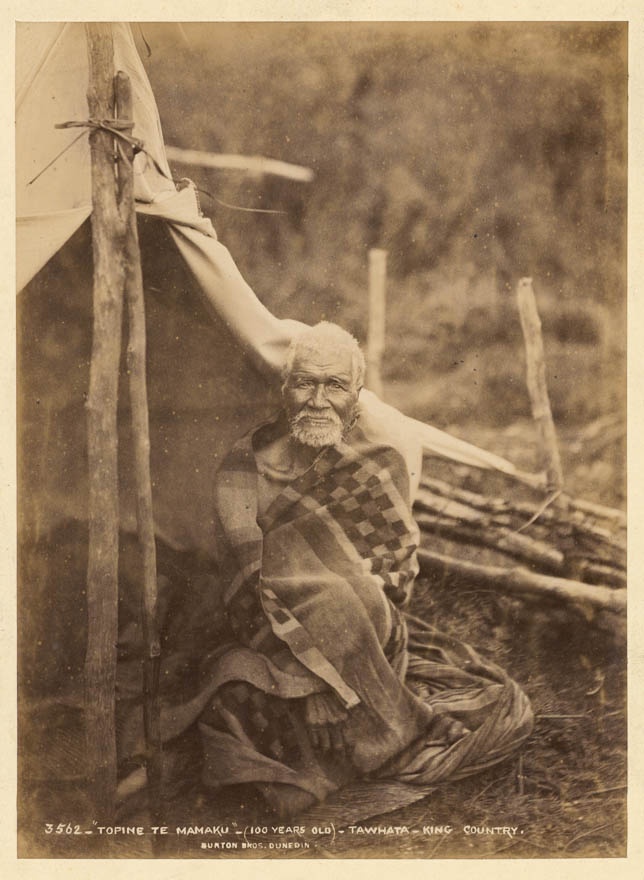
Tōpine Te Mamaku at Tāwhata, on the Whanganui River below Taumarunui, photographed in May 1885 by Alfred Burton.
In the early 1820s, Te Mamaku (Ngāti Hāua-te-rangi) wanted his people to join the migration of Te Rauparaha and Ngāti Toa to Kāpiti, but was dissuaded by Te Peehi Tūroa. In 1829 both men were caught up in Te Rauparaha’s siege of Pūtiki, near the mouth of the Whanganui River. They managed to escape and fled upriver.
In 1846, Te Mamaku and some 200 Ngāti Hāua-te-rangi fighters supported Te Rangihaeata and Ngāti Rangatahi in their dispute with the European settlers in Hutt Valley. He led the attack on Boulcott’s farm in May 1846 and asked other Whanganui chiefs to join him in fighting the Wellington settlers. The missionary Richard Taylor intercepted his letters and one reached George Grey, influencing the governor’s decision to arrest Te Rauparaha.
When four upriver Māori were executed for their part in the Gilfillan killings in April 1847, Te Mamaku laid siege to Whanganui with up to 700 men. After a minor battle in July the siege was lifted and Te Mamaku returned to his upriver stronghold near Pipiriki.
On Christmas Day 1853 Te Mamaku was baptised at Pūtiki by Richard Taylor, taking the name Hemi Tōpine (James Stovin). Conversion to Christianity did not mean he renounced war. In the mid-1850s a dispute broke out between Ngāti Hāua-te-rangi and Te Kere Ngātai-e-rua of Ngāti Tū, possibly over a flour mill under construction at Maraekōwhai. There was a battle at an old pā high above Kirikiriroa on the upper Whanganui, and subsequently a Ngāti Tū pā downstream at Puketapu was besieged.
Te Mamaku declined an offer to become the first Māori king in 1857, but joined the Kīngitanga the following year.
War returned to the Whanganui River in May 1864 when Mātene Te Rangitauira of Taumarunui led a Pai Mārire force against lower Whanganui Māori. Te Mamaku did not take part in the decisive battle at Moutoa, but he did support Te Peehi Pākoro Tūroa (Te Peehi Tūroa’s son) and a Pai Mārire force in a battle at Ōhoutahi, below Pipiriki, in February 1865.
Te Mamaku was said to be almost 100 years old when he died in June 1887 at Tāwhata.


Community contributions