
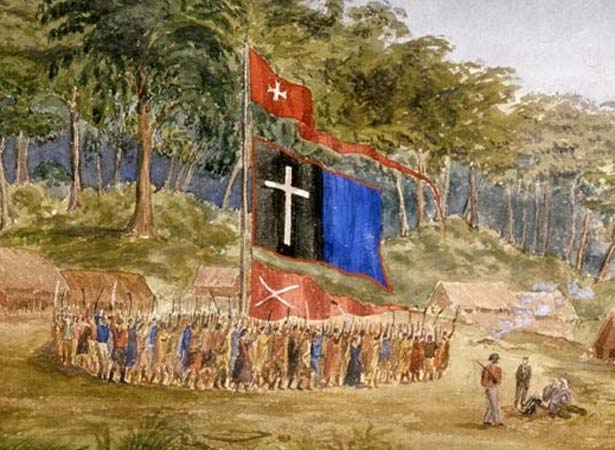
On the morning of 6 April a small British force left a redoubt at Kaitake, about 15 km south-west of New Plymouth.
Led by Captain Thomas Lloyd, No. 1 Company (Grenadiers) of the 57th Regiment and No. 9 Company, Taranaki Military Settlers were to destroy all Māori crops they found in the area. The force split into two, and while the main body waited for the return of the second party it was ambushed by Pai Mārire fighters at Te Ahuahu, near the present-day town of Ōakura.
Seven soldiers were killed and 12 wounded. Those killed were decapitated and their heads carried off by Pai Mārire disciples. These heads were then taken from tribe to tribe in order to encourage recruits to enlist. Māori witnesses later claimed that Lloyd’s head was taken by Kereopa Te Rau across the island to Ōpōtiki in eastern Bay of Plenty. The head of another slain soldier, Private Gallagher, was allegedly taken to the Gisborne/East Cape region by another Pai Mārire prophet, Patara Raukatauri.
Pai Mārire had emerged in 1862 in response to the conflict over land in Taranaki. Its founder, Te Ua Haumēne, based the new religion on the principle of pai mārire – goodness and peace. He called his church Hauhau: Te Hau (the breath of God) carried the news of deliverance to the faithful. The terms Pai Mārire and Hauhau became interchangeable as labels for followers of this religion. Against a backdrop of war and land confiscation, the founding principle of Pai Mārire was often subverted by violent elements, as in the case of the ambush at Te Ahuahu.
To most Pākehā, Pai Mārire was synonymous with fanaticism and barbarism, and fundamentally anti-European. Many Māori also opposed the movement, fearing that it would undermine the sovereignty of iwi.
Read more on NZHistory
The death of Carl Völkner – Pai MarireProphets and colonists – New Zealand's 19th-century warsPai Mārire – Pai Marire
External links
How to cite this page
'Pai Mārire ambush in Taranaki', URL: https://nzhistory.govt.nz/pai-marire-ambush-at-oakura-taranaki, (Ministry for Culture and Heritage), updated 13-Oct-2020


