See historic events for any day of the year by entering the date below. Why not try your birthday?

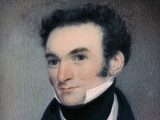
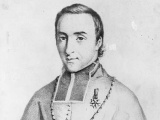
French Bishop Jean Baptiste François Pompallier, a priest and brother of the Society of Mary, arrived at Hokianga. His party celebrated the first Roman Catholic mass three days later.
Pompallier left France in 1836 with four priests and three brothers of the Marist Order to lead the pioneering Catholic mission to Western Oceania. His arrival in New Zealand alarmed James Busby, the Official British Resident, who feared that this was a forerunner to a French attempt to colonise New Zealand.
The English Church Missionary Society had established a mission in New Zealand in 1814. The first Wesleyan (Methodist) mission followed in 1823. Both wanted Maori to become Protestant and adopted a relatively hostile position to the new French mission. Maori responded to this rivalry in various ways. If one tribe or hapu adopted Catholicism, a rival often adopted Anglicanism. Maori sometimes covered their bets; different members of their community became Anglican while others chose Wesleyan or Catholic faiths.
Pompallier attended the Treaty negotiations at Waitangi in February 1840. He was sympathetic to Maori concerns and asked Lieutenant-Governor Hobson for his promise to protect the Catholic faith. This pledge is sometimes referred to as the unwritten ‘fourth article’ of the Treaty. It sought to protect and recognise not only major western religions, but also Maori custom.
Pompallier died in France in 1871. In 2002 his remains were returned to New Zealand where they were interred at Motuti, Hokianga.
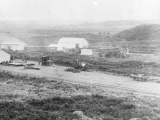
A French printing factory established at Kororareka is the last remaining building of the mission headquarters. It is not only New Zealand's oldest Catholic building, but the oldest industrial building in the country.
Image: Bishop Pompallier

George Hood and John Moncrieff’s flight was described as a ‘gallant if somewhat ill-organised attempt to be the first to fly the Tasman from Australia to New Zealand’. They took off from Richmond, Sydney, in the early hours of 10 January 1928 in the Aotearoa. The 1450-mile flight to Trentham, Wellington, was expected to take 14 hours.
This attempt at aviation history had captured the public’s attention and by late afternoon 10,000 people had joined Laura Hood and Dorothy Moncrieff to welcome their husbands at Trentham Racecourse. They waited in vain. Radio signals were picked up for 12 hours but after that all contact was lost. The aviators were never seen again.
On 11 September 1928 Australians Charles Kingsford Smith and Charles Ulm achieved what Hood and Moncrieff had died attempting, when they landed the Southern Cross at Wigram, Christchurch.
Image: John Moncrieff and the monoplane, Aotearoa. (Timeframes)