
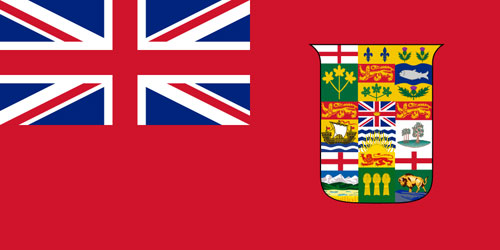
Flag
1914 Map
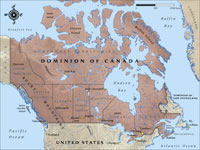
Click on map for more detail
General facts
- Population: 7.8 million (1914)
- Capital: Ottawa (1915 population 102,000)
Government
- Head of State: King George V (6 May 1910 – 20 January 1936)
- Head of Government:
- Prime Minister Robert Borden (10 October 1911 – 10 July 1920)
- Prime Minister Arthur Meighen (10 July 1920 – 29 December 1921)
Participation in the War
- Entered the war: 4 August 1914 (British Empire declared war on Germany)
- Ceased hostilities: 11 November 1918 (armistice with Germany)
- Ended belligerent status: 10 August 1920 (Treaty of Sèvres signed with Ottoman Empire)
Military Forces
Army
- Peacetime strength 1914: 3100 (Permanent Forces)
- Reserves 1914: 60,000 (Non-Permanent Active Militia)
The Canadian Expeditionary Force (CEF)
- Total mobilised during the war: 619,636
- Total sent overseas: 425,821
Immediately after the declaration of war against Germany the Canadian government offered to raise an expeditionary force for service overseas alongside British imperial troops. The British government accepted the offer and voluntary recruitment for the ‘Canadian Expeditionary Force’ (CEF) began on 7 August 1914.
The troop convoy carrying the first contingent of the CEF left its assembly point in Gaspé Bay, Quebec, for the United Kingdom on 3 October 1914. The convoy consisted of 32,000 soldiers and 7500 horses embarked on 31 transport ships. It arrived at Plymouth, England on 15 October 1914. The Canadians were allocated a portion of Salisbury Plain, a large chalk plateau covering parts of the counties of Hampshire and Wiltshire, in which to set up their training camps and other base facilities. In 1916 the New Zealanders and Australians would also establish base camps on Salisbury Plain.
The CEF on the Western Front
On 8 November 1914 No. 2 Canadian Stationary Hospital, Canadian Army Medical Corps, was transported across the English Channel and disembarked at Boulogne, becoming the first unit of the CEF to land in France.
The CEF served almost entirely on the Western Front. By the end of 1916 some 80,000 Canadian troops were in the trenches, serving in four infantry divisions that were grouped together as the ‘Canadian Corps’. This played a leading role in most of the British offensives on the Western Front from mid-1916, including the later stages of the Battle of the Somme, the Third Battle of Ypres (Passchendaele) and the breaking of the Hindenburg Line in late 1918. The most famous victory won by the Canadians during the war was the capture of Vimy Ridge (9–12 April 1917).
Lance–Corporal Frederick Fisher VC
Western Front, 22 April 1915: Lance–Corporal Frederick Fisher, 13th Battalion, Canadian Expeditionary Force, fights a lone rearguard action to cover the retreat of a nearby artillery battery during the Second Battle of Ypres. Fisher, the leader of a machine-gun section, single-handedly holds off a German infantry attack after the rest of his section is killed or wounded. He is eventually overwhelmed and killed by the Germans, but the artillery battery is saved. For his actions Fisher becomes the first soldier of the CEF to be awarded the Victoria Cross.
The CEF In Palestine
A small unit of railway troops, the 1st Canadian Bridging Company, was sent from France to join the British and Anzac forces in Palestine in September 1918. It arrived in the region a month before the Ottoman Turks agreed to an armistice and carried out repair work on the rail network until February 1919.
Navy
- Peacetime strength 1914: 350
Fleet (1914)
- Cruisers: 1
- Light cruisers: 1
- Submarines: 2
Royal Naval Reserve
- Personnel: 3000
Upon mobilisation men of the Royal Naval Reserve were called up to serve in the Royal Navy. They were soon scattered across the globe in all sorts of postings to all sorts of British ships and shore bases. It is thought that approximately 1 in 10 of the estimated 3000 Canadian Royal Naval Reservists called up during the war died while on active service with the Royal Navy.
Conscription
- Introduced: 29 August 1917
- Total conscripted by end of war: 125,000
- Total number of conscripts sent overseas by the end of the war: 25,000
The Compulsory Military Service Act was passed by the wartime Union government of Prime Minister Robert Borden. This was a fragile coalition between Borden’s Conservative Party and a number of members from the opposition Liberal Party. The Compulsory Military Service Act was opposed by every French Canadian Member of Parliament and caused much friction between the French Canadians of Québec and the rest of the country (the majority of which voted in favour of it).
Under the Act, all men aged between 20 and 45 were liable for service in the CEF. Only those deemed medically unfit for overseas service, working in civilian jobs essential to the war or officially recognised as conscientious objectors were granted exemptions.
Casualties (CEF only)
- Dead (all causes): 59,680
- Wounded: 149,732
- Total casualties: 209,412
Sources
- René Chartrand, The Canadian Corps in World War I, Osprey, Oxford, 2007
- David Mackenzie (ed.), Canada and the First World War: Essays in Honour of Robert Craig Brown, University of Toronto Press, Toronto, 2005
- Spencer C. Tucker (ed.), The Encyclopedia of World War I: Volume 1, ABC-CLIO, Santa Barbara CA, 2005
- Alexander Turner, Vimy Ridge 1917: Byng’s Canadians Triumph at Arras, Osprey, Oxford, 2007


