
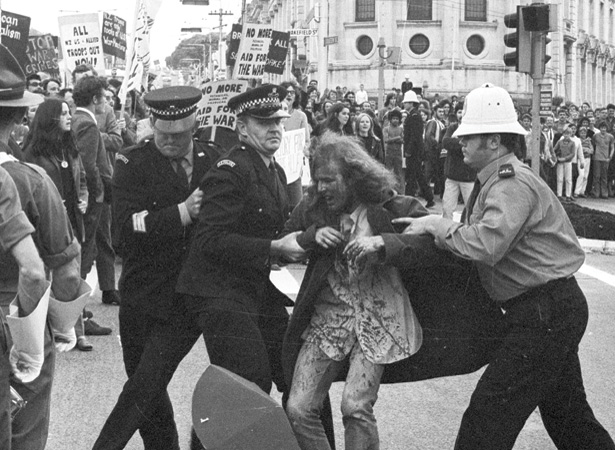
Anti-war protesters disrupted a civic reception in Auckland for New Zealand soldiers returning from the Vietnam War.
The civic parade was led by the Band of the Royal New Zealand Artillery, which was followed by Land Rovers carrying the gunners of 161 Battery and troopers from New Zealand’s Special Air Service. The march was relatively uneventful until the column reached the reviewing platform outside Auckland Town Hall.
As the parade approached the platform, red paint bombs and fire crackers were thrown onto the road. Demonstrators used red paint to symbolise bloodshed in Vietnam. Several paint-covered protesters broke from the crowd and sat on the road, forcing the band to alter course but causing only a momentary disruption before police removed them.
New Zealand’s involvement in the Vietnam War aroused considerable public debate. By 1971 up to 35,000 people were protesting on the streets around the country. Many argued that the conflict was a civil war in which New Zealand should play no part. They wanted this country to follow an independent path in foreign policy, not take its cue from the United States.
Read more on NZHistory
Overview – The Cold WarKeith HolyoakeProtest and dissent – The Cold WarThe Vietnam War – Vietnam War
External links
How to cite this page
'Anti-Vietnam War protests in Auckland', URL: https://nzhistory.govt.nz/anti-vietnam-war-protests-on-queen-street, (Ministry for Culture and Heritage), updated 7-Oct-2021


Community contributions