
Kiwi of the Week

  • yvette-williams-jump.biog.jpg

    Yvette Williams

    The sports writer Peter Heidenstrom rated Yvette Williams as his 'New Zealand Athlete of the Century'. There is no doubt that she was one of our greatest-ever athletes - and probably the most versatile. 

This WeeK's Quiz

Today in History

previous12 Maynext

rss feed
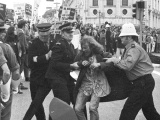
Anti-Vietnam War protests in Queen Street

1971 Anti-Vietnam War protests in Queen Street

A civic reception for 161 Battery on its return from Vietnam was disrupted by protesters who accused New Zealand soldiers of being murderers and threw red paint, symbolising the Vietnamese blood on their hands.

The Vietnam War was this country's longest and most controversial 20th-century military engagement. New Zealand's involvement aroused considerable public debate here as in other countries. One protest march in April 1971 saw up to 35,000 people take to the streets. Many protestors argued that the conflict was a civil war in which New Zealand should play no part. They wanted New Zealand to follow its own independent path in foreign policy, instead of following the decisions of others.

Between June 1964 and December 1972 nearly 3400 New Zealand service personnel served in Vietnam. Compared to the First and Second World Wars, our contribution in terms of personnel was small. At its peak in 1968 the New Zealand force only numbered 543 − 37 died while on active service and 187 were wounded.

New Zealand Prime Minister Keith Holyoake's approach to Vietnam was cautious. Under American pressure, the government agreed in 1963 to provide a small non-combatant military force. In June 1964, 25 Army engineers arrived in South Vietnam, where they were engaged in reconstruction projects, such as road- and bridge-building. In May 1965 Holyoake announced the government's decision to send 161 Battery, Royal New Zealand Artillery, to South Vietnam in a combat role. The artillerymen were later joined by infantry units. The Battery returned home in May 1971 after providing virtually continuous fire support (mainly to Australian and New Zealand infantry) for six years.