
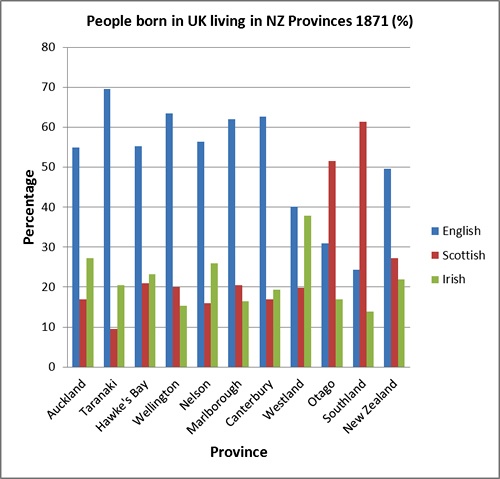
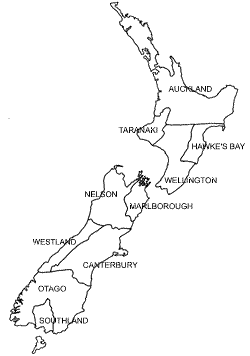
British-born population living in New Zealand provinces in 1871
 |
|||
|---|---|---|---|
| English | Scottish | Irish | |
| Auckland | 54.9% | 17% | 27.2% |
| Taranaki | 69.6% | 9.5% | 20.5% |
| Hawke's Bay | 55.2% | 20.9% | 23.2% |
| Wellington | 63.5% | 20% | 15.4% |
| Nelson | 56.4% | 15.9% | 25.9% |
| Marlborough | 62.1% | 20.4% | 16.4% |
| Canterbury | 62.7% | 16.9% | 19.4% |
| Westland | 40.1% | 19.9% | 37.9% |
| Otago | 31% | 51.5% | 16.9% |
| Southland | 24.4% | 61.4% | 13.9% |
| New Zealand | 49.7% | 27.3% | 22% |
*The Welsh have not been included in these figures as they made up less than 2% of the population of any province
The table and graph suggest:
- There was strong regional variation within New Zealand as to where different groups settled.
- In the 19th century Wellington and Canterbury provinces were dominated by the English. This in part reflects their New Zealand Company origins.
- Auckland had a strong representation from Ireland which reflected partly the influence of the early military settlers and partly the free migration of Irish across the Tasman to Auckland.
- Westland also had a large number of people from Ireland. Many of these were miners who had migrated across the Tasman from the Victorian gold fields to the West Coast gold rushes.
- Otago and Southland had a majority of British immigrants who came from Scotland. Again this reflected the character of the first organised settlement.


