

The British Resident
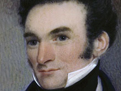
In 1832 James Busby was appointed as the official British Resident to New Zealand, a role equivalent to a consular officer. Even for the British government this was a matter of no great significance; until the late 1830s the Colonial Office had little interest in New Zealand.
Busby was given very little official support and had no means of enforcing his authority. The power of his word as an Englishman, and an official one at that, was supposed to be enough. Keen to keep costs down, Britain refused to station a warship in New Zealand, and as a civilian, Busby could not command troops. Māori soon nicknamed Busby ‘Man-o-war without guns’.
Busby took steps to tame what he saw as a chaotic frontier society. Less than a year after his arrival in May 1833 he orchestrated the selection of New Zealand’s first official flag. In 1835 he encouraged 34 northern chiefs to sign A Declaration of the Independence of New Zealand. The signatories called upon King William IV of Britain to become their ‘father and protector’. The Declaration was another step towards a formal constitutional relationship with Britain, which was cemented with the signing of the Treaty of Waitangi in 1840.


