
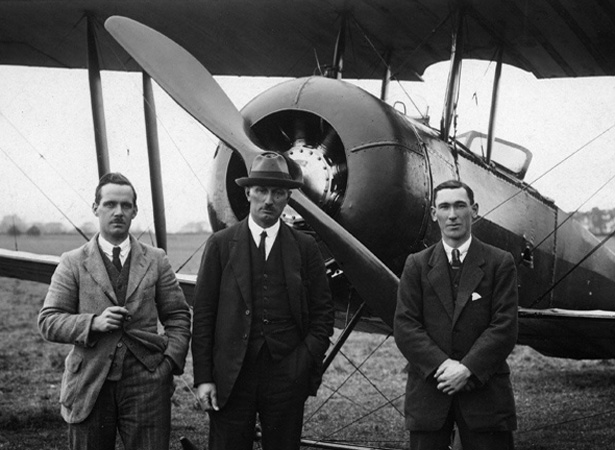
Captain Euan Dickson completed the first air crossing of Cook Strait, flying a 110-hp Le Rhone Avro from Christchurch to Upper Hutt with the first air mail between the South and North Islands.
Dickson was flying for Henry Wigram’s Canterbury Aviation Company and was accompanied by the company’s deputy chairman, C.H. Hewlett, and chief mechanic, J.E. Moore. The company wanted to survey the route between Christchurch and Wellington, identifying suitable landing grounds and refuelling points, to prove that mail and passenger services could be undertaken safely. It hoped to win government support for the establishment of commercial services and secure itself a regular income.
Dickson’s plane left Sockburn aerodrome, Christchurch, at 7 a.m., flying into a gusty north-easterly which depleted its fuel. He was forced to make an unscheduled landing in a paddock on the Kahutara River flats, just south of Kaikōura, where the crew managed to secure ‘motor spirit’ and a cup of tea.
A scheduled stop in Blenheim attracted only a small crowd, as Dickson had kept his plans secret. He had learned that Auckland’s Walsh brothers had established a temporary aerodrome at Hutt Park racecourse and were aiming to cross Cook Strait from the north. Like Wigram’s company, the Walshes were looking for new sources of income in the post-war era. The first Vivian Walsh and his team knew of Dickson’s flight was when the aircraft flew over them en route to Trentham racecourse in Upper Hutt.
Among the people who rushed into the city’s streets when the plane appeared over Wellington were parliamentarians assembling for the day’s session. By the time the aircraft landed at Trentham at 2.10 p.m. Cabinet minister Gordon Coates, who had ‘a very keen interest in aviation’, had sent Dickson a message of congratulations. After acknowledging this and other telegrams, the aviators lunched in the officers’ mess with Trentham camp’s commanding officer, Colonel C. Guy Powles.
The journey had taken just over 7 hours, with a flying time of 4 hours 40 minutes. Dickson, who had served as a bomber pilot in the First World War, commented that the trip was ‘more difficult’ than crossing the English Channel.
Three days later Dickson and Moore began their return journey – the first from north to south across Cook Strait. They spent a few days in Blenheim, where this time a large crowd greeted them. Here Dickson took nearly 200 people on joy rides, making over £500 ($45,000 in 2020 values) from flight and gate charges, Viewing the aircraft cost a shilling ($4.50). Before returning to Christchurch on 6 September, Dickson noted that the South Island had won a victory ‘which could not be taken away’.
A few months later, in January 1921, the government’s Air Board directed the Canterbury Aviation Company to begin an airmail service from Christchurch to Ashburton and Timaru. This failed to attract the custom it needed to make a profit and the Air Board closed it down three months later. The company continued to struggle and in 1923 the government purchased its land and assets as the base for the newly formed Permanent Air Force.
External links
How to cite this page
'First flight across Cook Strait', URL: https://nzhistory.govt.nz/page/first-flight-across-cook-strait, (Ministry for Culture and Heritage), updated 6-Sep-2023


Community contributions