See historic events for any day of the year by entering the date below. Why not try your birthday?

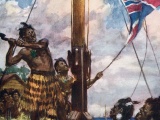
Initially supportive of the Treaty of Waitangi, Heke became increasingly disenchanted with the effects of European colonisation. He expressed this through repeated assaults on the symbol of British power. This was his third attack on the flagstaff at Kororareka (Russell).
Hone Heke chopping down the British flag at Kororareka is an enduring image from New Zealand history. Traditional interpretations portrayed him as a ‘rebel’ who was finally subdued by the actions of ‘good Governor George Grey’. This interpretation failed to acknowledge the complexities of the conflict and the unresolved issue of Maori authority in the initial period after the signing of the Treaty of Waitangi. Hone Heke himself had been the first Maori to sign the Treaty.
Heke's first assault on the flagstaff came in July 1844 when Te Haratua, his right-hand man, chopped it down. The British re-erected the flagstaff, but it was felled again on 10 January 1845. Heke's third assault followed on the 19th. A fourth and final attack on the flagstaff on 11 March resulted in the outbreak of war in the north.
Sometimes referred to as 'Hone Heke's rebellion' or the 'Flagstaff War', this was no simple matter of Maori versus Britain. It was a complex three-way war where two factions of Ngapuhi fought against each other. Hone Heke and Kawiti fought the Crown as well other Ngapuhi led by Tamati Waka Nene. The fighting ended in January 1846.

Nineteen men were killed when an explosion ripped through the Strongman Mine at Runanga just after 10 a.m. An investigation concluded that safety regulations were not followed and that the shot was incorrectly fired.
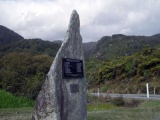
Located near Greymouth, the Strongman mine (New Zealand's largest underground coal mine) had enjoyed an impeccable safety record since its opening in 1939. All that changed in January 1967 when an explosion sent a fireball through a section of the mine. There were 240 men working in the mine at the time. An even greater death toll was avoided because the fireball hit a wet patch in the tunnel near the explosion which caused it to slow and then extinguish itself.
Smoke and firedamp (methane gas produced by coal) made the task of searching for survivors and bodies particularly dangerous. When mixed with a certain level of air, firedamp becomes highly explosive and those involved in the rescue were at constant risk of another explosion. Fourteen bodies were recovered that day. It took another three weeks to retrieve two more bodies. The tunnel was sealed off before the last two could be recovered. A number of those involved in the rescue received the British Empire Medal for their bravery.
An inquiry into the disaster concluded that at least two mining regulations had been broken. The government was ordered to pay compensation to the families of the victims.
New Zealand's worst mining disaster remains the explosion at Brunnerton on the West Coast in 1896 in which 65 were killed.