
What happened that day?

Kiwi of the Week

  • wiremu-te-rangitake-biography.jpg

    Wiremu Kingi Te Rangitake

    Te Ati Awa leader Wiremu Kingi Te Rangitake's refusal to give up his land at Waitara led to the outbreak of the Taranaki War. In later life joined the pacifist community at Parihaka

This WeeK's Quiz

Today in History

previous28 Marchnext

rss feed
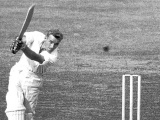
NZ cricketers skittled for 26

1955 NZ cricketers skittled for 26

In recent years test matches between New Zealand and England have been keenly contested. This was not the case in 1955. At Eden Park, Auckland, on 28 March 1955 New Zealand cricket experienced its darkest day, when its 11 batsman could muster only 26 runs against England. This total remains a world record low – and, unlike most cricketing records, it is one that may never be beaten.

The test had started with some promise. After only scoring 200 runs in its first innings, the New Zealand team felt it had put itself back in the match when it dismissed England for 246. Satisfaction was short-lived. In its second innings New Zealand slumped to 26 all out off 27 overs; only opener Bert Sutcliffe reached double figures, scoring 11 runs.

When New Zealand toured England in 1958 it fared little better, being dismissed for 47 and 74 in the second test. New Zealand suffered many defeats at English hands before finally winning a test, at Wellington's Basin Reserve in February 1978. Needing only 137 to win, the English slumped to be 64 all out, with Richard Hadlee capturing 6 for 26. This first victory – at the 48th attempt – was a tribute to perseverance, and it was enthusiastically welcomed as proof that we could at last compete on the cricket pitch with our former colonial masters. 

Image: Bert Sutcliffe (BBC)

Signing of CER strengthens Tasman trade ties

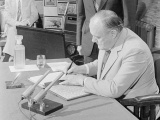
1983 Signing of CER strengthens Tasman trade ties

The Australia-New Zealand Closer Economic Relations Trade Agreement (ANZCERTA), better known as CER, was New Zealand's first comprehensive bilateral trade agreement - and one of the first agreements of this kind in the world.

Although CER came into force on 1 January 1983, the agreement was not formally signed until 28 March that year, by the New Zealand High Commissioner in Canberra, Laurie Francis, and Lionel Bowen, Australian Deputy Prime Minister and Minister for Trade. CER built upon the earlier New Zealand Australia Free Trade Agreement (NAFTA), which had been in place since 1966.

By 1990, free trade in goods and nearly all services had been achieved. In recent years both countries have moved towards even closer cooperation in policies, laws and regulatory regimes. CER has been a model for other bilateral trade relationships, and has been described by the World Trade Organisation (WTO) as ‘the world's most comprehensive, effective and mutually compatible free trade agreement'.

Image: detail from Polish publication about CER (Gdansk University