
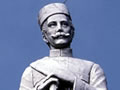
There are more than 60 memorials in New Zealand to the dead of the New Zealand Wars. But their story is strikingly different to that of the memorials put up in memory of those who died in the country’s other major conflicts, the South African War and the First and Second World Wars. In those cases memorials were erected within a decade of the war to provide surrogate tombs for men and women who had died and were buried overseas. But the dead of the New Zealand Wars had died in this country. Some were initially remembered by headboards at their place of burial, but the erection of memorials took more than a century and reveals a fascinating chronology of different motives and people.
During the Wars: 1843–1872
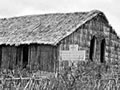
Apart from wooden headboards on individual graves, or stone monuments for collective graves (such as those put up in the Mission cemetery in Tauranga and Makaraka cemetery near Gisborne), only three free-standing stone memorials were erected in New Zealand during the wars themselves. There were two main reasons for this lack of memorialisation. First, the idea of commemorating the ordinary soldier through a memorial was a very new one, only really established in the British Empire by memorials put up in Britain to the dead of the Crimean War of the 1850s. Second, the Pākehā community did not want to celebrate or commemorate the New Zealand Wars. The conflict was a frustrating one with few clear-cut victories, and those were often the result of the efforts of imperial soldiers rather than locals. People preferred to forget, rather than remember, painful and somewhat embarrassing events.
The three memorials put up during the wars are an unusual collection:
- The first was the powerful monument of a weeping woman put up in Whanganui ‘To the memory of those brave men who fell at Moutoa 14 May 1864 in defence of law and order against fanaticism and barbarism’ (as the inscription reads). The ‘fanatic barbarians’ were up-river Hauhau who decided to come down the Whanganui River and drive off the white settlers in Whanganui township. They were defeated by lower-river Māori in a ritualistic battle on Moutoa Island in the middle of the river. In gratitude and relief at their salvation, the locals put up a monument within 15 months of the affair. It contains the names of 15 Māori fighters and lay brother Euloge, from the nearby Catholic mission, who was shot while trying to end the fighting.
- The second memorial was more traditional. It honoured an Ōtāhuhu settler, Marmaduke George Nixon, who had raised a band of volunteers and died after being wounded at Rangiaowhia in February 1864. That he was a local and a volunteer, not an imperial officer, probably explains the fact that the memorial was put up as a result of public subscription.
- The third memorial had a very different genesis. The 57th Middlesex Regiment served in the Taranaki and Waikato wars. Before leaving New Zealand in 1867 they decided to remember their dead comrades by putting up an obelisk in the Te Henui cemetery in New Plymouth.
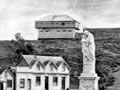
Two other monuments erected during the wars of the 1860s recalled events of the 1840s:
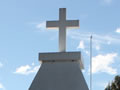
- Politician Edward Jerningham Wakefield, keen to see his uncle Arthur Wakefield commemorated, organised a pyramid in the Tuamarina cemetery to the memory of the 22 settlers killed in the Wairau affray of 1843. The inscription noted that they were ‘killed … by natives of New Zealand’.
- At the other extreme, both geographically and in sentiment, a church was built near Ōhaeawai in Northland by local Māori as a symbol of peace and a tribute to Pākehā who had died in battle on the site in 1845.
1872–1905
For the 30 years after the wars, people preferred to forget. What disturbed the amnesia was the rotting of wood and the growing of bracken. Periodically an old settler or a visiting English veteran would search out the graves of their comrades and express shock at their condition. On occasion there were even questions in the House of Commons.
One way out of this embarrassment was to replace rotting headboards with a collective memorial. The result was monuments at St John’s church in Te Awamutu, Rangiriri cemetery, Ōkaihau in Northland, and Pōkeno in south Auckland (a striking monument in the form of a pyramid of leaning rifles). When fire destroyed headboards at Nukumaru, the soldiers’ remains were reburied beneath a new monument on the hill above Whanganui.
1906–1920
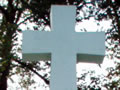
In the first two decades of the new century, more than 20 memorials to the New Zealand Wars were built. There were a number of reasons for this:
- There was a widespread desire by Pākehā New Zealanders to recall their pioneers – whether early settlers or soldiers – in stone monuments.
- The erection of memorials to the South African War inspired people to see the value of war memorials.
- With growing public concern about the rise of Germany’s military power, there were increasing efforts to raise consciousness of military obligations to the Empire. Memorials to those who served in the New Zealand Wars were seen as a way to provide an example of imperial service to the younger generation. Edith Statham, who became secretary of the graves committee of the Victoria League, was a prime mover in this spirit. In May 1913 she was appointed as inspector of old soldiers’ graves in the Department of Internal Affairs. Statham was responsible for getting the government to pay for a dozen monuments in cemeteries and battlegrounds in the North Island.
- The 50th anniversary of battles of the New Zealand Wars helped turn people’s attention back to the wars. An obelisk at Ōrākau and two memorials in Hawke’s Bay were unveiled on the anniversaries of the battles.
- As they neared the end of their lives, veterans were keen that the efforts of themselves and their mates should not be forgotten. In south Taranaki, veterans James Livingston and John Finlay were responsible for local monuments.
1925–1930
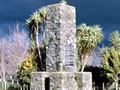
At least 12 memorials were erected in this new burst, which was partly inspired by the experience of building memorials to the Great War. It is possible too that the publication of James Cowan’s two-volume history of the New Zealand Wars and the screening of Rudall Hayward’s film, Rewi’s Last Stand, awakened interest. A couple of these memorials are interesting: a stone pillar to kūpapa (Māori who fought alongside the Pākehā) that was erected at Ōmāhu, near Hastings; and a large monument at Turuturumokai, near Hāwera, donated by a local man.
1950–
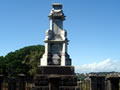
The Historic Places Trust established in 1954 put up markers and plaques at significant battle sites. Once again anniversaries, this time centenaries, were a major incentive for initiatives at Gate Pā, Moutoa Island and Ōrākau.
From the 1970s the emergence of Māori radicalism raised new questions about how the New Zealand Wars had been memorialised. In some places, such as St Mary’s church in New Plymouth, new memorials were put up which acknowledged the pain on both sides. In other places, such as the Wakefield Street monument in Auckland and the soldier memorial on Marsland Hill in New Plymouth, significant damage was done to monuments by a new generation expressing its resentment at the imperial sentiments carved in stone.
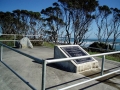
In more recent times considerable effort has been made by the Heritage Operations unit of the Ministry for Culture and Heritage to maintain and restore the government-owned memorials. In 2002 the unit was responsible for erecting the Katikara memorial in Taranaki, the most recent government-funded New Zealand Wars memorial.
The memorials to the New Zealand Wars were never just monuments to the dead. They were always invested with highly political meanings. Both the erection and the desecration of monuments said more about contemporary politics than it did about the events that were being commemorated.
Jock Phillips, 2010
Find out more about individual memorials in the Media Gallery
See also: Memorials and monuments (Te Ara)


Community contributions