
Mangahao hydro scheme opened
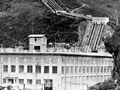
Hydroelectricity was a key driver of economic growth in the 1920s. Early in the decade Public Works Minister Gordon Coates set up a regulatory framework for electricity generation and reticulation, and initiated several major state hydro schemes. The power station at Mangahao in the Tararua Range near Shannon was opened by Prime Minister William Massey on 3 November. Construction had been hampered by the risk of sudden flooding and the difficult tunnelling required – seven workers were killed on the job. At the time Mangahao was New Zealand’s largest power station; today it is one of the smallest still operating.
All Black ‘Invincibles’ begin triumphant tour
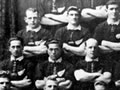
Between September 1924 and February 1925 the All Black rugby team played 32 games in Britain, Ireland, France and Canada, including four test matches (against Ireland, England, Wales, and France). Scoring 838 points and conceding only 116, they won all their games, earning the nickname of the ‘Invincibles’. The 19–0 victory over Wales in Swansea on 29 November exacted some revenge for the controversial defeat suffered by the 1905 ‘Originals’. England was defeated 17–11, Ireland 6–0 and France 30–6. The touring team was captained by Cliff Porter, and included renowned players such as fullback George Nēpia, five-eighths Mark Nicholls and Bert Cooke, and forwards Cyril and Maurice Brownlie.
Rātana tries to petition the King
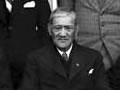
Māori spiritual leader Tahupōtiki Wiremu Rātana took a petition signed by more than 30,000 Māori to London. The petition called for the return of confiscated lands and for the Crown to honour promises made in the Treaty of Waitangi. Rātana hoped to meet King George V but was not allowed to. A member of his group also tried and failed to present the petition to the League of Nations in Geneva. But Rātana’s actions did help persuade the New Zealand government to set up a commission of inquiry into Māori land confiscations (the Sim Commission) in 1926.
Riding the Night Limited
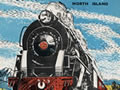
The Night Limited Express between Auckland and Wellington, which was to become probably New Zealand’s most famous train, made its first run on the North Island main trunk line in December. The service was introduced at the urging of Railways Minister Gordon Coates, who sought to revitalise New Zealand Railways in the face of mounting motor competition. By limiting the number of stops and carriages, the train made the journey in 14¼ hours, instead of the 18 hours taken by the normal expresses. A Daylight Limited trialled in 1925–26 proved less popular and was later mainly confined to holiday periods. The Night Limited ran until 1971, when it was replaced by the all-sleeper Silver Star (1971–79) and the overnight Northerner (1971–2004).
Other events in 1924:
- New Zealander Arthur Porritt won the bronze medal in the 100-m dash at the Paris Olympics. The race was later dramatised in the film Chariots of fire. Porritt went on to serve as New Zealand’s Governor-General from 1967 to 1972.
- The first trans-global radio transmission was sent from New Zealand to London. Amateur radio operator Frank Bell sent the ground-breaking Morse code message from his family’s sheep farm in Shag Valley, Otago.
- Professor Robert Jack of the University of Otago began experimenting with television. Four years later he transmitted pictures within his laboratory.
- As the number of cars, trucks and motorcycles grew rapidly, the Motor Vehicle Registration Act 1924 provided for a centralised system of vehicle registrations administered by the Post Office.
- Compulsory voter registration was introduced for all eligible European electors (but not Māori, as there were still no electoral rolls for Māori seats).
- A strike by the 11,000-strong Amalgamated Society of Railway Servants (ASRS) ended in defeat.
- The Arawa District Trust Board (later Te Arawa Maori Trust Board) was established following a settlement with the government over ownership of the Rotorua lakes.
- The Maori Purposes Fund Control Board was set up to administer funds from unclaimed rent payments on Māori land and other sources.
- Pensions for the blind were introduced, following lobbying by the Women’s Christian Temperance Union and other groups. By 1929, 282 people were receiving blind pensions.
- ‘Granny’ Maher became the first woman to be licensed as a professional racehorse trainer in New Zealand.


Community contributions