See historic events for any day of the year by entering the date below. Why not try your birthday?

The Academy Award-winning film Chariots of Fire (1981) was based on the true story of British athletes competing in the 1924 Paris Olympics. At the end of the film one of the main characters, Harold Abrahams of Britain, wins gold in the 100-metres final. Jackson Scholz of the United States finishes second, while a New Zealander named ‘Tom Watson' finishes third. The character was based on Arthur Porritt who won a bronze medal for New Zealand in the 100 m in 1924, but reportedly refused permission for his name to be used in the film out of modesty.
Porritt was one of only four New Zealanders at the 1924 Olympics. He suggested that he was selected not only because he was New Zealand's fastest sprinter but because it was cheap to get him to Paris. At the time he was just over the Channel studying medicine at Magdalen College, University of Oxford.
On the day of the final about 30,000 spectators saw Porritt, Abrahams, Scholz and fellow Americans Charley Paddock, Loren Murchison and Chet Bowman compete in the 100 m. Scholz was the fastest away and still led at the halfway point, but with 20 m to go Abrahams edged ahead to win in a time of 10.6 seconds. Scholz was second (10.7 s) and Porritt third (10.8 s).
New Zealanders had competed in athletics at previous Olympics, and Taranaki walker Harry Kerr had won a bronze for the Australasian team in 1908, but this was the first track medal won by New Zealand - and, significantly, it came in one of the Games' glamour events. It was an amazing feat considering that Porritt was probably the only athlete in the field that day not to have been coached prior to the Olympics. Following the Games he trained under Abrahams' coach, Sam Mussabini, and in 1925 he beat the gold medallist over 100 yards. Until Abrahams' death in 1978 the two men and their wives dined together at 7 p.m. every year on 7 July, the day and hour of their final.
Porritt's involvement in the Olympics continued long beyond 1924. He was team captain in Amsterdam in 1928, but withdrew from the 100 m due to injury. By then a trained physician, he treated members of the New Zealand team, including boxer Ted Morgan who went on to win gold. Porritt was then team manager at the 1936 Berlin Olympics, where he crucially advised Jack Lovelock to compete in the 1500 m, which he won, rather than the 5000 m.
From 1934 to 1967 Porritt was the New Zealand member of the International Olympic Committee (IOC). He greeted New Zealand teams when they arrived in London en route to various Olympics, arranging medical treatment, accommodation, training facilities and equipment. He also presented Yvette Williams (1952), Murray Halberg (1960) and Peter Snell (1960 and 1964) with their Olympic gold medals. Sir Arthur Porritt was accorded life membership of the IOC in 1967 when he left to become Governor-General of New Zealand (1967-72).
Image: Still from Chariots of Fire showing 'Tom Watson' (Arthur Porritt) (See clip on YouTube)

The new political party emerged from a joint conference of the United Federation of Labour, Social Democratic Party (SDP) and local Labour Representation Committees (LRCs) in Wellington.
Since the early 1900s a number of candidates had stood for Parliament under various 'labour' banners, including the Socialist Party, the Independent Political Labour League, local LRCs, the first New Zealand Labour Party (1910-12), the United Labour Party (ULP) and the SDP, which had been formed at the 1913 Unity Conference in Wellington.
By 1916 there were six 'labour' members in Parliament − three elected as members of the now-defunct ULP, two as SDP candidates and one as an independent − who operated as a de facto opposition to the wartime coalition government. This grouping formed the basis of the second New Zealand Labour Party, which was established at a conference instigated by the SDP in Wellington in July 1916. Although the party's name was a concession to the moderates, it was dominated by SDP members, who held 11 of the 13 positions on its founding executive.
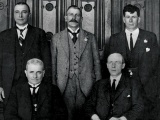
Image: the Labour Party leadership in 1922 (detail). See full image and reference on the DNZB website.