
Māori did not lack non-violent ways of resolving disputes. Diplomacy, arranged marriages, gifts, asset-stripping (taua muru) and escape were all used to avoid fighting. But when these methods failed, acquiring more weapons sometimes seemed the only answer.
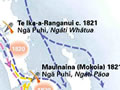
Initially, Bay of Islands communities armed themselves with muskets for self-defence against Hongi’s hapū. Then the heavily armed northern tribes attacked those to the south, who had few or no muskets. Panic helped Ngāpuhi secure many of its victories. The muskets remained unreliable, but stories of their devastating power were enough to ensure that those who had yet to face them lived in great fear. The spiral of war, trade and more war reached a high point in the early 1820s.
Tribes threatened with attack had no choice but to buy their own guns and launch their own campaigns. In 1822 Ngāti Toa, led by Te Rauparaha, fought their way down the North Island from Kāwhia to Kāpiti. They were joined by sections of other tribes as they went. Waikato tribes led by Te Wherowhero got muskets and attacked Taranaki iwi, some of which migrated south to join Ngāti Toa in a confederation that came to rival that of Ngāpuhi. This confederation defeated an opposing alliance before attacking Ngāi Tahu in the South Island.
The eclipse of Ngāpuhi
Another taua into Arawa territory (Rotorua) in 1823 involved 3000 Ngāpuhi, but the strain was beginning to show. Māori society lacked the infrastructure to maintain campaigns on this scale – warriors were also needed as farmers and fishermen. Hongi’s next taua – into Ngāti Whātua territory in 1825 – numbered only 350.
Ngāpuhi dominance had begun to wane as other iwi acquired muskets. Maori were also learning how to adapt their pā to withstand musket fire. Earthworks, trenches and heavier palisades made successful attack much harder. The death of Hongi also hastened the end of large-scale campaigning. He was severely wounded in 1827 while fighting his Ngāti Uru kin at Whangaroa. He lingered, partially paralysed, until March 1828. Even then, Hongi’s enemies feared a revenge attack by Ngāpuhi.


