
Fighting in North Africa stemmed from the area’s strategic importance to the Commonwealth. Egypt’s Suez Canal, connecting the Mediterranean Sea to the Red Sea, was a vital transport artery, while the Middle East oilfields were crucial to sustaining the Allied war effort. Italy’s decision in June 1940 to enter the war on Germany’s side seriously jeopardised Britain’s position in Egypt. Italian forces in Libya and Abyssinia (Ethiopia) dwarfed the 36,000 British troops in the region. This threat became real when 250,000 Italian troops crossed the Libyan border into Egypt in September 1940.
Key dates
13 September 1940:
Italian forces invade Egypt.
9 December 1940:
First Western Desert offensive begins. New Zealand troops involved.
18 November 1941:
Operation Crusader begins.
1 July 1942:
First Battle of El Alamein begins.
23 October 1942:
Second Battle of El Alamein begins.
13 May 1943:
German-Italian forces in North Africa surrender.
The 2NZEF in Egypt
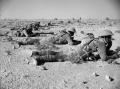
New Zealand troops began arriving in Egypt in February 1940. The First Echelon of the 2nd New Zealand Expeditionary Force (2NZEF) – formed after New Zealand declared war on Germany in September 1939 – established a large camp at Maadi, 12 km south of Cairo. Another smaller camp was set up 12 km further south at Helwan. Germany's rapid occupation of France and the Low Countries in May-June 1940 removed the possibility of 2NZEF being sent to Western Europe, although the Second Echelon was diverted to help defend Britain against possible German invasion. By early 1941 this threat had largely subsided and these men joined the First and Third Echelons in Egypt. The 2NZEF was ready for action.
The main fighting element of 2NZEF was the 16,000-strong 2nd New Zealand Division. ‘The Div’ was commanded by First World War Victoria Cross (VC) winner Major-General Bernard 'Tiny' Freyberg, who also commanded 2NZEF. After returning to Egypt following the disastrous campaigns in Greece and Crete, the New Zealand Division entered the fray in North Africa during Operation Crusader in November 1941. For the next year, they saw action in the western part of Egypt, with several forays into Libya.
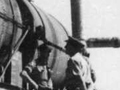
Alongside the Division's field engineers, who excelled in the desert fighting, other specialist support units played a vital role in transporting and supplying allied forces, a challenging task given the huge distances and harsh environment. By the end of 1940 seven New Zealand railway units were operating in Egypt, including railway construction, survey and operating companies.
Enemy forces
The New Zealanders saw little action during the initial stages of the North African campaign. Most of the fighting took place between the Western Desert Force (composed of British, Indian and Australian troops) and Italian forces. British and Commonwealth troops did not think much of their 'Itie' opponents. Some units fought well, but in general the Italians were badly equipped and poorly led. Many Italian troops were ambivalent about fighting on the German side and unwilling to give their lives for a cause in which they did not believe.
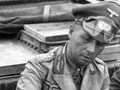
In February 1941 the first elements of the Deutsches Afrika Korps (German Africa Corps) arrived to bolster the Italians, then reeling from a series of Allied blows. Commanded by General Erwin Rommel, an officer whose bold tactics earned him the moniker ‘Desert Fox’, this small force soon made its mark in the campaign.
Life in the desert
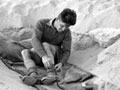
Conditions in the desert were very tough. Cold nights and searing daytime temperatures made life uncomfortable for soldiers in forward positions – shade was hard to find and makeshift shelters did little to block the sun. Sandstorms were a regular hazard, and dust stirred up by vehicles and shellfire covered everything.
The lack of water to drink, let alone to wash or shave in, was a constant source of annoyance. So were the flies. Desperate for moisture, they settled on lips or sweaty shirts by the hundreds. During daylight hours men struggled to eat as flies swarmed on their food or dived into their drinks. One inevitable result was dysentery, a miserable experience. Mosquitoes were less prevalent but more lethal, for in some areas they carried malaria. Adding to the men's misery were desert sores – any scratch rapidly became a suppurating mess. Everyone, it seemed, sported bandages.


