
Disasters at Ruweisat and El Mreir
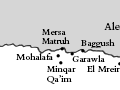
Following the breakout at Minqar Qaim in late June 1942, the New Zealand Division fell back to the Alamein Line, where it took part in the first Battle of Alamein. At Ruweisat Ridge on 15 July 1942, and the El Mreir Depression a week later, the New Zealanders seized their objectives after successful night assaults. But on both occasions they were left unsupported by British armoured units, and when German tanks appeared they had no choice but to surrender.
The inability to get anti-tank and other heavy weapons forward to the New Zealanders contributed to the debacles at Ruweisat and El Mreir. But its main cause was the failure of the British armour to move forward. Faulty orders and a lack of initiative on the part of the exhausted British tank commanders lay at the heart of the problem. The 4th, 5th and 6th (NZ) Brigades suffered heavy casualties in these battles, and several thousand more New Zealanders were captured.
A stalemate developed on the Alamein Line. Rommel, conscious that a lack of reinforcements and supplies were weakening his position in North Africa, tried to grab the initiative before it was too late. On 30 August 1942 German and Italian forces breached the Alamein minefields and headed south in an attempt to outflank the Allied forces. Deciphered German codes – dubbed ULTRA intelligence by the Allies – allowed the Allies to track Rommel’s intended movements and they pounded his columns with artillery and from the air. Having made little progress and with his tanks short on fuel Rommel fell back to his original positions. This action marked the debut of the 8th Army’s new commander, Lieutenant-General Bernard Montgomery. While he was fortunate to assume command just as conditions began to favour the Allies, Montgomery had more than good luck on his side. He brought a new uncompromising approach to the campaign, immediately indicating that there would be no thought of further retreat.
Breakthrough at El Alamein
The New Zealand Division played a key role in the second Battle of El Alamein, which began on 23 October 1942. Its task, along with South African, Australian and British divisions, was to 'break in' through the enemy defences, which were now covered by deep minefields. At 9.40 p.m. the skies around El Alamein lit up as around 900 guns opened fire on known Axis positions. Twenty minutes later the infantry began their assault, advancing forward under a First World War-style creeping barrage. While the New Zealanders seized their objectives, the overall battle did not develop as Montgomery expected. Congestion, poor coordination and cautious leadership prevented Allied armoured units from taking advantage of gains made by the infantry.
Montgomery planned a new attack – Operation Supercharge – further to the south, which would essentially repeat the process of the initial attack. He looked to the New Zealand Division's experienced headquarters to plan the ‘break in’ component of Supercharge, although the division itself was too weak to provide the necessary punch. Two British brigades, with New Zealand support, would carry out the attack while New Zealand infantry battalions protected their flanks.
Operation Supercharge began at 1.05 a.m. on 2 November, with the British infantry brigades forcing open a path for British armour to pour through. Having breached the prepared Axis positions, the tanks ran into Rommel’s panzers (German tanks). Both sides incurred heavy losses in the ensuing battle, but by evening the Afrika Korps was facing defeat. Realising his battered armoured units were fast running out of fuel, Rommel decided to withdraw. Despite Hitler ordering the German-Italian troops to ‘stand fast’, by 4 November Axis forces in North Africa were in headlong retreat. Many Italian troops, without adequate transport, were taken prisoner. Rommel’s defeat at El Alamein would prove to be the decisive moment of the North African campaign.
The Axis position in North Africa was furthered weakened when Anglo-American forces landed in Vichy-French Morocco and Algeria in November 1942. To meet the new threat, Axis forces poured into Tunisia, forming a new army commanded by General Hans-Jurgen von Arnim. The Germans and Italians were now fighting on two fronts.


