
New Zealanders were only marginally involved in the initial British operations that drove the Italians out of Egypt late in 1940. New Zealand airmen served in British air and naval units in the Mediterranean theatre, while the cruiser HMNZS Leander patrolled the Indian Ocean. As British forces crushed the Italians in Abyssinia, elements of the Deutsches Afrika Korps (German Africa Corps) began arriving in Libya and the 2nd New Zealand Division departed for Greece in March 1941. Both developments ensured that the battle for North Africa would be a lengthy campaign.
Operation Crusader
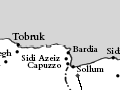
With Allied attention focused on Greece, General Erwin Rommel transformed the situation in Africa. Driving east, he forced the Allies back into Egypt, leaving an Australian Division besieged in the Libyan port of Tobruk. After two unsuccessful attempts to relieve Tobruk, General Claude Auchinleck, C-in-C Middle East, decided to launch Operation Crusader – a large-scale infantry and armoured offensive designed to crush the Afrika Korps and lift the siege. This operation would provide the setting for the New Zealand Division’s first foray into the desert.
Operation Crusader was a victory of sorts, but it came at a heavy price. Rommel smashed the British armour and inflicted heavy losses on the infantry in front of Tobruk. Despite these tactical successes, equipment and supply shortages forced him to pull back to El Agheila, leaving the battlefield to the battered British 8th Army. British forces were able to relieve Tobruk and headed westwards in pursuit.
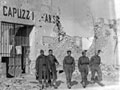
Freyberg's men had fought well in their first desert battle. As British and German tanks clashed further south, the New Zealanders advanced toward the coast – taking Fort Capuzzo and pressing onto towards the towns of Sollum and Bardia. The New Zealand Division dispersed at this point to cover different areas – 5th (NZ) Brigade was to cover the enemy garrison at Sollum; 4th (NZ) Brigade moved north to isolate Bardia; while 6th (NZ) Brigade was directed westwards to the Sidi Rezegh escarpment, about 40 km south-east of Tobruk. On 23 November 6th Brigade suffered heavy casualties trying to capture Point 175, with 25th Battalion losing over 100 men – the worst casualties suffered by a New Zealand battalion in a single day during the whole war.
More bad luck was to befall the New Zealanders. Rommel, falling back after an unsuccessful attempt to relieve Axis units around the Libyan-Egyptian border, ran straight through New Zealand lines from the south-west, overrunning 5th Brigade headquarters in the process. Several New Zealand battalions also suffer heavy casualties as German tanks swept over the escarpments at Sidi Rezegh and Belhamed. For the third time that year thousands of New Zealanders went into captivity – but unlike those captured in Greece and Crete, who were taken to Germany and Yugoslavia, these men were destined for prisoner of war (POW) camps in Italy.
In the aftermath of Crusader, the New Zealanders licked their wounds back in Egypt. With 879 dead and 1700 wounded, the New Zealand Division had fought its most costly battle of the war. In February 1942, at the New Zealand government's insistence, they moved to Syria to recover.
Breakout at Minqar Qaim
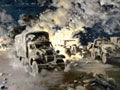
In Syria, the New Zealanders spent much of the time improving defences and training. Allied strategists were concerned that the Germans could attack from the north through Turkey and threaten the British position in Egypt. For the troops it was an enjoyable break from the heat of the desert.
The New Zealand Division’s sojourn ended after Rommel launched a fresh offensive in the Western Desert. In May 1942 German-Italian forces broke through at Gazala on the Libyan coast and rapidly captured Tobruk. Recalled from Syria, the New Zealanders took up defensive positions at Mersa Matruh, around 450 km west of Cairo. Seeking a more mobile role for his division, Freyberg moved the New Zealanders further south to Minqar Qaim.
Within days rapidly advancing German forces had cut the New Zealanders off from Allied forces to the east. The only chance of saving the division lay in a breakout through the ring of German forces blocking the way. In the early hours of 28 June 1942, the New Zealand Division, led by 4th Brigade, burst through enemy lines, using their bayonets to telling effect in the savage hand-to-hand fighting that ensued. As the attack proceeded, the majority of the division slipped through a gap further south.


