
Wahine disaster
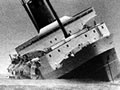
At around 6.40 a.m. on 10 April the inter-island ferry Wahine, with 734 passengers and crew on board, struck Barrett Reef at the entrance to Wellington Harbour. Would-be rescuers stood helplessly on the beach at Seatoun as the Wahine succumbed to Hurricane Giselle, one of the worst storms recorded in New Zealand history. This country’s deadliest modern maritime disaster, the Wahine wreck would ultimately claim 53 lives.
Īnangahua earthquake
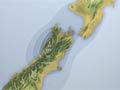
At 5.24 a.m. on 24 May Īnangahua Junction, a small community 40 km east of Westport, was the epicentre of a magnitude 7.1 earthquake. The violent shaking threw some residents from their beds. Two died when a limestone bluff collapsed onto a farmhouse. A motorist was killed near Greymouth when he hit a section of road that had subsided at a bridge approach. Three men also died later when a rescue helicopter crashed.
A number of landslides were triggered by the tremors. One dammed the Buller River above Īnangahua Junction, raising the river 30 m above its normal level. With the water backed up for 7 km Inangahua and Westport were at risk should the dam burst. This threat forced the evacuation of everyone in its path.
John Rowles breaks into UK top 10
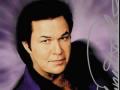
While a number of New Zealand musicians had cracked the Australasian market no one had really made the next big step until John Rowles arrived in London in late 1967. Competing against established stars like Tom Jones and Engelbert Humperdinck, the boy from Kawerau had a huge hit with his first UK release, 'If I Only Had Time'/'Now Is the Hour'. It cracked the top 10 in the UK, Australia and New Zealand. His follow-up single, 'Hush Not a Word to Mary'/'The Night We Called It A Day', also made the top 20 in all three countries. During the late 1960s Rowles established himself as New Zealand's premier international artist. He is best remembered for the 1969 hit single 'Cheryl Moana Marie', which sold a million copies worldwide.
Death of Sir Walter Nash
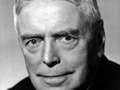
Walter Nash was Prime Minister in the second Labour Government (1957-60). He had been associated with the Labour Party since its creation in 1916 and first entered Parliament by winning the Hutt Valley (Wellington) seat in a 1929 by-election. He continued to represent this seat until his death. He was Minister of Finance in the first Labour Government (1935-49) and became leader of the party in 1951.
His leadership was severely tested during the controversial 1951 waterfront dispute. While addressing a rally in Auckland he stated that Labour was ‘not for the waterside workers, and we are not against them’. This bid to be impartial backfired badly. He was ridiculed by his political opponents and the press for years afterwards. In the snap election that followed Nash and Labour were humiliated, winning only 30 of the 80 seats. But Nash confirmed his status as one of the great survivors of New Zealand politics when, at the age of 75, he led Labour to victory in the 1957 election.
Other events of 1968
- Allison Durbin won the Loxene Golden Disc Award for I Have Loved Me a Man. These awards were the forerunner of today’s Tui Awards or New Zealand Music Awards.
- The Wattie Book Awards (forerunner of the Montana New Zealand Book Awards) began. The first winner was John Morton and Michael Miller’s The New Zealand Sea Shore. J. T. Salmon’s 2nd Field Guide to the alpine plants of New Zealand came second and Lloyd Geering’s God in the New World third.
- Wellington hosted the ministerial conference of the South-East Asia Treaty Organisation (SEATO). With the Vietnam War the major topic for discussion, a coalition of anti-war groups met at the same time.
- The current affairs show Gallery began, hosted by Brian Edwards.
- The New Zealand men's coxed fours won the gold medal at the Mexico City Olympics. Mike Ryan won a bronze in the men’s marathon, while Ian Ballinger also won bronze in the men's small-bore rifle shooting.
- For the first year (other than during a major war) the number of females exceeded the number of males. There were 99.8 men per 100 women.
Can you remember 1968? Add your memories and comments in the form below.


Community contributions