
First steel produced from local ironsand
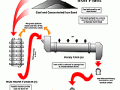
In 1959 the government established the New Zealand Steel Investigating Company. Its brief was to determine the technical and economic feasibility of manufacturing steel from local raw materials. After initially relying on scrap iron to produce steel when it first opened in 1968, New Zealand Steel's new mill at Glenbrook, south of Auckland, developed new techniques enabling it to make use of the abundant supplies of local ironsand (titanomagnetite).
The ‘Save Manapouri’ campaign
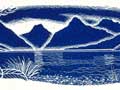
At a public meeting in Invercargill in October the ‘Save Manapouri' campaign was officially launched. This was a response to plans to raise the level of Lake Manapouri by 8 metres for a hydroelectric power scheme to supply a new aluminium smelter at Tiwai Point, Bluff. The opposition to this proposal was New Zealand's first mass environmental movement. It is considered by many to be the birth of New Zealand's ‘green movement'.
Many New Zealanders opposed the project because of its ecological impact. Others were concerned that the power needs of the Comalco (an overseas consortium) smelter were taking priority over the interests of New Zealanders. In May 1970 the Royal Forest and Bird Protection Society presented to Parliament a petition with more than 260,000 signatures opposing the project. Following its victory in the 1972 general election Labour passed legislation protecting the lake's level. Six Guardians were appointed to oversee the management of the lake all of whom had been prominent leaders of the Save Manapouri Campaign, including Ron McLean.
Rainbow II wins prestigious One Ton Cup
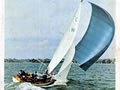
New Zealanders have a formidable reputation as sailors. In the various Olympic classes, America's Cup or the great ocean classics such as round-the-world and Sydney to Hobart, Kiwis have punched above their weight in yachting. On 21 July 1969 (the same day that the first moon landing was broadcast) news arrived from Heligoland, Germany, that New Zealander Chris Bouzaid had won the prestigious One Ton Cup with his homemade Rainbow II. Despite the distraction of the moon mission, New Zealanders followed the racing from the North Sea with great excitement as Bouzaid defeated the German holder in four successive races. His victory not only secured the Sportsman of the Year award for 1969 but ensured that New Zealand emerged as a major force in world yachting.
Introduction of blood and breath alcohol limits for drivers
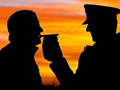
In 1960, 374 New Zealanders lost their lives in road accidents. By 1969 the number had increased by almost 200. New Zealanders were driving more powerful cars prompting calls for increased speed limits. These occurred in 1962 when the open road speed limit increased from 50mph (80km/h) to 55mph (88km/h) and again in 1969 to 60mph (96km/h). While speed was identified as one of the factors contributing to our ever-increasing road toll, so too was drink driving. In 1969 blood alcohol and breath testing procedures were introduced to tackle this problem. A limit of 100mg of alcohol per 100ml of blood was set. The breathalyser was adopted as a screening device to help test for drivers over this limit.
Other 1969 events
- New Zealand's first major oil strike was announced at the Maui I well off the Taranaki coast. Exploration for oil in the Maui II field began later in 1969.
- Archbishop Peter McKeefry became New Zealand's first Catholic cardinal
- ‘Nippon clip-ons' widened the Auckland Harbour Bridge from four lanes to eight
- Twenty-year-olds were allowed to vote in general elections for the first time
- James K. Baxter established a community at Jerusalem on the Whanganui River and began referring to himself as ‘Hemi'
- Shane won the Loxene Golden Disc Award for ‘Saint Paul'. These awards were the forerunner of today's Tui Awards or New Zealand Music Awards.
- A Lion in the Meadow was published, launching the career of the acclaimed New Zealand children's writer Margaret Mahy.
- Shortly after midnight on 22 June 1969 a lahar on Mt Ruapehu destroyed the kiosk at the Whakapapa ski field. The time of the incident ensured no skiers were at risk.
Can you remember 1969? Add your memories and comments in the form below.


Community contributions