
What happened that day?

Kiwi of the Week

  • freyberg.biog.jpg

    Bernard Freyberg

    A First World War hero and commander of the 2nd New Zealand Expeditionary Force, Bernard Freyberg was British-born but New Zealand-raised. He proved to be a charismatic and popular military leader who would later serve a term as Governor-General

This WeeK's Quiz

Today in History

previous14 Novembernext

rss feed
DPB legislation introduced

1973 DPB legislation introduced

The passage of the Social Security Amendment Act introduced the Domestic Purposes Benefit to New Zealand's social welfare system. Paid out from 1 May 1974, the DPB was set at a level that enabled sole mothers to stay home to care for their children without relying on paid employment.

The introduction of the Old Age Pension in 1898 and the landmark Social Security Act of 1938 saw New Zealand earn an international reputation for progressive social policy. The concept of state care from the ‘cradle to the grave’ became an established part of New Zealand life.

Prior to 1973 the government supported families by supplementing the wages of widows and sole mothers who worked. The 1972 Royal Commission on Social Security recommended a new benefit which was to be set at a level high enough to allow sole mothers to stay home to care for their children.

The aim of the Domestic Purposes Benefit was to help women with a dependent child or children who had lost the support of a husband, or were inadequately supported by him. It was also available to unmarried mothers and their children, and to a father who was the sole parent of one or more children. Women who were living alone and cared for incapacitated relatives could also claim the DPB.

The traditional image of the nuclear family had begun to change. The idea of the father going out to work while mum stayed home was not relevant to an increasing number of New Zealanders. Attitudes to marriage in general were changing and statistics indicated a rise in the number of sole parents. These changes had forced a re-think of how sole parents were supported when relationships ended. (The Act treated de facto relationships as marriages.)

Critics complained that this benefit would lead to an explosion in the numbers of sole parents. It was argued that it would be too easy for men to simply walk away from their responsibilities and that this new benefit would place an unfair burden on the taxpayer. The DPB was seen as encouraging sole parents to opt out of the workforce.

While men could claim the DPB, the vast majority of those claiming the benefit were women, leading to the creation of a new class of New Zealander, the ‘solo mum’. During tougher economic times solo mums became synonymous with what critics complained was wrong with the welfare state. Those receiving the DPB were somehow ‘ripping off the system’.

Others argued that the DPB was an important right for women. It gave them and their children some protection from failed relationships that were potentially harmful. They also argued that the amount paid was barely enough to provide the basic necessities for them and their children so was hardly an incentive for anyone to give up work without needing to.

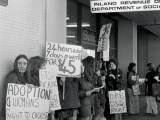
Image: Women protesting in 1977

George Grey arrives in NZ

1845 George Grey arrives in NZ

Grey served two terms as Governor and later one as Premier. His most notable achievement was probably his management of Maori affairs between 1845 and 1853.

Image: George Grey